The final installment of books looking at London hidden hydrology is Walking on Water: London’s Hidden Rivers Revealed, by Stephen Myers.  As part of the parade of books on the topic published in 2011, this takes a very different approach than the tour/photo guides of Talling and Bolton, reflecting Myers’ background as an engineer.  If you’ve checked out the previous post on the Barton book, you’ll recognize some of this similar analysis, as the 2016 3rd Edition of ‘The Lost Rivers of London’ includes Myers as a co-author, and seems a hybrid of this book and Barton’s earlier versions.

On that note, Myers approaches the project from that engineering perspective, and its loaded with info.  A blurb from Amazon:  “London’s hidden – or lost – rivers are a source of fascination. This book concentrates on seven North London rivers – the Fleet, the Walbrook, the Tyburn, the Westbourne, Counter’s Creek, Stamford Brook and the Black Ditch. The author, a professional water engineer, describes their sources and traces their individual histories, setting out their influence on the development of London and their use and abuse by society, eventually leading to their disappearance. The original watercourses of each of the seven rivers are shown on London street maps to a detail never previously attempted. Research to enable this included extensive on-site analysis of their river catchment topographies and desk-top studies of numerous old maps and literary references. Walking on Water ends on an optimistic note. Drawing on his professional experience, the author proposes a practical, affordable and exciting approach to recreating riverside parks and walks in the London boroughs through which the hidden rivers passed, which uses their source waters to refresh the lakes of the Royal Parks.”

Myers breaks down the history of hidden rivers, discusses a good amount on geology and the form of the rivers, and discusses their ‘uses and abuses’, all info covered in other places, but again with a unique focus here.  The second half of the book includes specific rivers, an overall map shows some of the North Bank Rivers (click to enlarge) covered, including all the usual suspects from other books.

Also of interest is a comparative profile, showing the central London Rivers.  The relationship of the rivers in terms of altitude from headwaters to outfall is a complement to plan relationships, and particularly in the context of London where all the rivers flow into the same source, the Thames, it allow for some good comparison.

The development of the City of London is of great interest, named the chapter ‘A City Grows, Its Rivers Beggared’ and how this rapid urbanization impacted the rivers both in demand for fresh water and degradation due to pollution.  The diagram below (which would have aided with some color and texture) shows the expansion of the city, notably the sprawling growth between 1800 and 1900 (marked by the gray inner zone and outer black line).

And while the chapter on ‘Mapping London’s Hidden Rivers’ is helpful in outlining the methodology, the results that come from this work are less than stellar.  All the diagrams and maps here are black and white, using a base map derived from the Geographers A-Z Map Co (similar to Barton & Myers) which again offers legibility and usability issues that leave a lot to be desired.  While the maps in the 2016 book were in color, they seemed overly detailed and took away from the routes of the rivers. In this case, black and white flattens it all out and their small size makes the cramped and difficult to use.  A good hybrid would be a black and white base with the paths drawn in color, perhaps?

As Myers makes a point multiple times, “it was a considerable surprise to learn that there were no large-scale maps, readily accessible to the general public, which showed their routes through the metropolis.” (14)  Perhaps Barton’s original 1962 book insert doesn’t totally qualify as ‘accessible’, but it does, and much more successfully, provide a large scale map of the routes that Myers was missing. He does mention obviously using Barton, and also references a book I had not heard about previously, London Under London by a very appropriately named duo for the task, Trench & Hillman.  Another reference was to a future volume, “Walking on Water – the Hidden Water Walks” to follow this one, but I’ve not found any mention that that project came to fruition.  So perhaps that was going to be the vehicle for better, user friendly maps, that never materialized.

For each river chapter, he does include the sections of the routes, again in very small size, which I think are very helpful for visualizing the routes of streams.

The final chapter does offer a strategy for a project entitled the Hamstead Water Conduit, where he speculates on a proposal that could “recreate short, clean stretches of the Central London rivers – more particularly the Fleet, the Tyburn, the Westbourne, and possibly, the Walbrook, the City of London’s own river.” (200).  He goes on to mention that “the source waters for the Fleet, the Tyburn and the Westbourne rivers are the springs and surface water which drain naturally from Hampstead Health.  These are the only source water of the hidden rivers that have been protected from pollution and which remain eminently accessible today.” (201)

A diagram shows a proposed route, which connects existing daylit portions with new or reconfigured surface channels in places, fed by the springs mentioned above.  While not a continuous river, the result is a linear water course that works with the boundaries of the existing city fabric while taking advantage of opportunities to create surface waters.  A “…‘feel-good’ project” but one with environmental benefits, flood mitigation, recreation, tourism, and infrastructure reduction. As noted by Myers, the social benefits as well, allowing us to “lift spirits in depressing times, but also contribute a small stimulus towards better economic times.” (208)

A more technical diagram shows some of the interconnections between the old and new systems, as well as the make-up water using existing groundwater stores (a metaphorical routing) and creating a water balance that kept water uses constant while using excess flows to ‘restore’ river segments.


The strength of this book, as indicated in the above analysis, is a solid, technical background in both the formation of rivers, the geological and hydrological framework in which these waterways emerged, the development implications that drove them underground, and some realistic considerations on why it would be difficult to daylight them, as they have been so fully consumed into the existing sewer systems. But also, some defensible and plausible daylighting strategies that take these multitude of factors into play.

The glossary ‘Watery Definitions’ on page 20 is a good touch, and discussion of what is a creek, stream, river, etc. is one that few tend to delve into in any detail.  As he mentions, due to size and typology, “it might seem more approrpriate to make reference to London’s ‘Hidden Streams’ rather than to London’s hidden rivers, as the flows in them could not really be described as ‘copious’ and their water surface widths generally lay in the narrow band of between 2 and 6 metres.  However, these watercourses have been referred to historically and collectively as ‘rivers’, and so this book will perpetuate that possibly inaccurate usage.” (22)

The Disclaimer at the beginning was interesting as well, as it seemed appropriate for anyone with a background in design and engineering to include the cover-your-ass language about accuracy, liability and not using the information for specific purposes.  This shows up also in the later Barton & Myers version of Lost Rivers, but does bring up a point about representation and what it could mean.  The accuracy of old maps .  He also warns about sewer exploration, I guess as well a necessary caveat for disseminating this type of information.

Each book I’ve covered offers something unique to the conversation, and this provides a great resource for those interested in London, but also a wider context of the emergence of urban creeks and rivers which seem applicable to all places.  A level of technical rigor also makes this a valuable companion to other resources that focus on places, history, landmarks and culture.


Jumping forward a bit,  the most recent of the books on London from June 2017 is another slim, exploratory volume, London’s Hidden Rivers by David Fathers.  Dubbed as “A walkers guide to the subterranean waterways of London’, this small book is extensive in scope and graphics.  From Amazon: “David Fathers traces the course of twelve hidden rivers in a series of detailed guided walks, illustrating the traces they have left and showing the ways they have shaped the city. Each walk starts at the tube or rail station nearest to the source of the river, and then follows it down to the Thames through parkland, suburbia, historic neighbourhoods and the vestiges of our industrial past. Along the way there are encounters with such extraordinary Londoners as William Blake, Judy Garland, Paul Robeson, Terence Donovan, Bradley Wiggins, Nelson, Lenin, Freud, and the great Victorian engineer Joseph Bazalgette.  Hidden Rivers of London contains over 120 km of walks, both north and south of the Thames. Winding through the hills, valleys and marshes that underlie the city, every page is a revelation.”

Fathers is an illustrator and map-maker, with a strong focus on walkiing guides, so this is in line with the other tour-specific guides, however, he visual and exploratory nature is inventive and really works with large, illustrated spreads (even in a small book), that highlight key points, while remaining focused on the route and the relation to the former waterway.  Text fills these empty spaces, in Fathers’ distinctive style.

There’s also a story beyond the story, not trying to get too much technical knowledge, but looking more at storytelling, for instance the Serpentine in Hyde Park, part of the route of the River Westbourne.  Some snippets of history, along with significant modern features, make for an interest mix.

I had seen snippets of his other books on the The London Thames Path and The Regents Canal, and really enjoyed encountering his work for the first time from this Londonist post, “The Lost London River With A Musical History“, which recounted one of the stories that eventually made it to the book, that of the River Westbourne, which “…like so many London streams over the past few hundred years, has been press-ganged by the demands of hygiene into becoming a sewer, and buried for the needs of ever more living space. And yet despite all this, the stream alone seems to have a mysterious, magnetic quality of attracting musicians to its banks.”  He recounts the experiences of a number of musical talents over history that were related to the hidden river, including below, where Judy Garland lived in 1969 (Site E) and Site G, which was the “site of the former Ranelagh Pleasure Gardens where a young Mozart gave a musical performance in 1764”  

A review from the Londonist mentions: “Each river is mapped in some detail, allowing the walker to follow closely, looking for clues: here a sloping side-road, there a gushing drain. The real joys are the little puddles of trivia that accompany each walk. Who knew that Lenin often frequented a fish and chip shop in the River Fleet valley? Or that Van Gogh fell in love on the banks of the Effra?”  Fathers had written often for the Londonist on the subject, with some great weekend walks along the routes of the Wandle, Lea, and Ravensbourne, with the expected maps and sketches, such as this from Ravensbourne.

You can follow him on Twitter @TheTilbury, and he’s also got some great info on all the books on his website, as well as this poster of the Thames, which “This full colour, illustrated poster, is packed with information about the architecture, bridges and monuments that line the banks of the River Thames as it flows through the capital city from Putney to Tower Bridge.”  

As I embark on the journey to document London’s hidden hydrology, it’s revealing how many books, websites, art installations, maps and more that have been created around lost rivers over the years.  To begin, I thought it prudent to start at the beginning, or at least the modern version of this, with The Lost Rivers of London by Nicholas Barton.  This may be considered the earliest version of a hidden hydrology publication I’ve seen, that is, exclusively focused on the disappearance of urban hydrological systems. This groundbreaking work was first published in 1962, with a subtext epitomized by the tagline: “A study of their effects upon London and Londoners, and the effects of London and Londoners upon them”.  Barton describes the endeavor:  “The purpose of this study is to show that these rivers, still silently flowing along beneath our feet though for the most part degraded into sewers, have played a considerable part in the development and history of London, and furthermore that their influence is still felt today… “ (14)

I purchased a copy of the 1962 book, and was excited about the inclusion of a fold up map which shows the the streams, which was a nice surprise, as I figured it would be missing  (also a snippet of this in the header of the map).  An image of this map I’d seen before online is this version, which can be found via this post from London By Gaslight from 2012, showing folds and all.  I ended up scanning version in the book and stitching it together (it’s about 20″x 17″) because I really like the simplicity and style of the map (Click for larger version).

If you zoom in, shows some of the great detail of what is a superbly crafted map from over 50 years back.   A zoom in shows a simple black and white line drawing with blue water (doesn’t get much simpler than that) along with some simple labels. The Westbourne, Tyburn, Fleet, and Walbrook wend through central London, and areas where it’s daylit such as the Serpentine in Hyde Park.

A further zoom shows the Rivers Walbrook and the Neckinger, along with Black Ditch, feeding the Thames on the east side.

The content of the book is organized around some of the main rivers on the north side, including the Walbrook, Fleet, and Tyburn, along with more geographically focused groupings to the west, south and east. There’s a fun section on ‘Dubious Rivers’ which questions some legends of these lost rivers.  The final section includes broader information on the uses of the rivers, and discussion of “Disasters, Diseases, and Drains” which includes analysis akin to John Snow’s mapping of cholera – in this case looking at incidence of bronchitis overlain with lost river paths to see if there’s a correlation.

It’s a pretty amazing book, especially when you think of when it was written, as it draws on a range of historical information that obviously was a bit less accessible in the mid 1960s.  I laughed when he mentions the following, in the Introduction, as it echoed what I feel most days: “For such a small theme, these lost rivers have been the subject of a considerable amount of literature, and an even greater amount of interest.  Nothing has surprised me more in studying them than the number of other people doing the same thing.  Yet in spite of this, there is only one book which purports to describe all the lost rivers (he’s referring to Foord’s 1910 ‘Springs, Streams, and Spas of London’) and even in this they are a secondary interest.” (14)

The sheer amount of rivers that ran through London leads to a number of interesting narrative opportunities, and the length of history of London adds to this potential creating an arc of time spanning centuries.  It also provides a partial story that is constantly in flux, as mentioned in 1962: “…there is no hard-and-fast distinction between those which are buried and those which are not… some of these streams are partly buried and partly not, and who can say that in a few years they will not be as much lost as their historically more distinguished predecessors?” (17)

The illustrations run the gamut beyond the map above which highlights rivers buried and open at the time, along with historical images such as woodcuts, here below of the Fleet River in 1825 and River Tyburn in 1750 (between pages 32-33)

More descriptive maps, such as the one below, showcase small scale concepts, such as the development of early sewers concurrent with development, in this case from 1679, highlighting sewers built by Richard Frith to alleviate problems from illicit sewers he had built earlier.  As mentioned by Barton: “This incident is only one of many clashes at this period between the authorities and the speculating builders who were so rapidly extending the fringe of London, and in tracing its consequences one gains a fascinating insight into this period of London’s history.” (52)

Another shows a much larger infrastructure intervention, the configuration of Bazelgette‘s 1858 interceptor sewers, which was driven by the ‘Big Stink’ and the need to ‘replumb’ the city to alleviate the health crisis created by the fouling of the rivers, as described by Barton: “Three large new sewers and the north and two on the south cross London from west to east, intercepting the old sewers on their way to the Thames.” (112)  The waste is then deposited at outfalls well downstream of the city, and the “old rivers are relegated to the function of storm relief sewers…” (113)  Thus a long-standing model for the transformation of many urban areas followed suit.

The book has an ample set of Appendices, including a good list of maps set in chronological order, and articles and books spanning back many decades.  The connection and historical use of the Rivers is a constant theme in the text, with stories of use and the connection of life and rivers for centuries.  This ideal is epitomized in this image from 1728, taken from Alexander Pope’s ‘Dunciad‘ shows the River Fleet, with the line:

“Here strip my Children! here at once leap in,
Here prove who best can dash thro’ thick and thin.”

As concluded in the original, Barton sums it up. “…despite the collective name by which these river are usually known and which forms the title of this book, they are not lost, but merely hidden: ‘a river can sometimes be diverted, but it is a very hard thing to lose it altogether’… The measure of the change is that today we need never stop to think about these streams, although they are still flowing silently along beneath our feet, ‘the ghosts of the rivers which once beautified Londong and the country round about…” (128)

FURTHER EDITIONS

This version was reprinted again in 1982 as the same text, and an official second edition shows up in 1996. The latter doesn’t mention any major changes, but does sport a new, color cover.  I don’t have a copy of either of these, so can’t vouch for any changes, but it is interesting to see the timeline from the original publication date, and at least a glimmer of interest that sustained multiple printings over the decades.

A reprint in the form of a third edition emerged in 2016 which, along with another author (Stephen Myers) and a tagline ‘Revised & extended with colour maps’.  It’s definitely an expansion of the original text, and it does incorporate ideas and parts of Myers’ 2011 book ‘Walking on Water’ which i will cover in a separate post, while including much of Barton’s original 1962 text, along with a new cover.

They do offer some new info, reported on London lost rivers expert Tom Bolton in this 2016 review from the Londonist, “Walbrook Stolen By Monks! New Lost Rivers Of London Has New Ideas” where he also refers to the original book as “London’s lost river bible”.    This update includes some specific route maps, which highlight the individual rivers, something that wasn’t part of the original text.  The route of the Fleet, shown below from headwaters to the Thames is a good example.

A more focused version shows the Tyburn flow around St. James Park, and the text allows for some visuals that were lacking in the original text about side channels and relationship of current conditions.

I also appreciate the sections showing the full route and overall elevations change, such as this for the Walbrook River below, with some modern reference points.

There’s a lot more imagery in this version, including more photographs and sketches, which is great, and they do cover a bit more in terms of history and context, adding chapters on development of London, and the key role of the rivers in defense, navigation, agriculture, fishing, mill-power and industry, as well as recreation.  They mention that, often prior to waterways being lost, they are manipulated for many of the purposes above, for instance, the story of the Fleet.  “After the Great Fire it was resolved to convert what had become a squalid nuisance into a beautiful asset. Under the direction of Wren and Hooke the lower 640 metres (2,100 feet) of the Fleet were deepened and widened, and an elegant canal created, 15.25 meters  (50 feet) wide, lined on either side by wharves… crossed with high bridges.”  (139) This modified Fleet is shown in the 1745 Rocque Map of London as the “Fleet Ditch”.

And while it was used for a time, in perhaps a refrain heard many times since, there “was not enough demand for a canal and too much demand for a street.”  After covering portions of it , “the wharves became roads and the central strip a long arcaded covered markets. The remainder of the canal was covered over in 1766, and the canal became a sewer.” (141)

Barton & Myers do get a bit speculative as well,with the last chapter Regaining an Asset, where they discuss the new visibility and popularity of lost rivers, and the desire to restore the physical and spiritual connections to these urban waterways.  They discuss a series of proposals for a number of of the rivers, including daylighting short stretches of the Walbrook, Fleet, Tyburn and Westbourne Rivers.  Beyond restoration, they do acknowledge “It is simply not possible to just open up long lengths of the Lost Rivers to the surface, particularly within the inner city, downstream. These stretches have been completely integrated into the sewer system.” (206)

The solution could be attained by tapping source waters high up in the watershed, stating that “The springs there may be the only source waters of the Lost Rivers which have escaped pollution and remain accessible.” (206)  An more expansive Fleet River Revival Project, seen below, would use gravity in “renewing a connection which existed before the rivers became polluted” (207) creating an abstracted system through the urban zones not following the exact route but taking advantage of current conditions to restore the general idea of the Fleet and other river corridors.

The update is a good exploration and adds a lot to the overall narrative, and the additional images, and the inclusion of the glossary is a nice touch.  They have, unfortunately jettisoned the fold-out map, and the internal maps, in my opinion, are not as effective, varying in scale, cropped and rotated weirdly, and overly detailed as to overwhelm the key hydrological information.  It’s funny to think of a book from 50 years ago actually having better maps than one published just a couple of years ago – but I guess it’s a case where color and detail isn’t always a positive, and this info in the hands of skilled mapmakers and graphic designers would make them more effective.

CONCLUSION

The book and its different editions provides a compelling history that is worth a deep dive.  Someone can prove me wrong, but I think the 1962 version, beyond some early tomes on springs and spas, is the oldest version of the hidden hydrology literature. And it still holds up today.  The updates add some technical rigor, and maps, but with the addition of the engineering co-author, it loses a lot of the original by trying to be too detailed and include too much explanation of routes, which is pretty boring reading.  If you are in London and at all interested, I’d look at a local bookstore or get online a track down a copy.  It’s worth a look.


HEADER:  Image from Barton’s original 1962 Map of London’s Lost Rivers.

Another fine resource that adds to the hidden hydrology knowledge base in New York City is Sergey Kadinsky’s Hidden Waters of New York City, which “serves as a guide to the stream by tracing their development along their courses” (xiii).  The book takes a different yet complementary direction than the Welikia project and other efforts I’ve mentioned and will follow up on.  Publishes in March, 2016, the book summary via Amazon provides some context: “Beneath the asphalt streets of Manhattan, creeks and streams once flowed freely. The remnants of these once-pristine waterways are all over the Big Apple, hidden in plain sight”

Kadinsky’s day job is at the New York City Parks Department, has experience as a tour guide, also teaches and contributes to Forgotten New York, all of which provides a good context for open spaces, as well as a forum for the stories of hidden and forgotten waterways of the area.  As he mentions in the brief introduction:

“The city’s waterways have become a place where the public is reminded of nature’s presence in the city.”  He continues mentioning specifically that inland areas, where “…waterways are not as visible, having been buried beneath the streets and concealed behind building. If one searches carefully, one can hear sounds of hidden streams churning beneath manholes and see traces of them in street names that recall a water past.” (xiii).

Covering Manhattan, The Bronx, Queens, Brooklyn, and Staten Island in different sections, the breadth of the book is it’s major take-home.  Any New Yorker would be doing themselves a favor by picking up a copy and being surprised to find out that you don’t have go far to find an interesting historical place you probably didn’t know about.  The short blurbs about each area come with a variety of factoids, as well as good local destinations and options for travel via bus, subway, and bike.

The content is great, albeit brief as the book covers, as mentioned on the cover, “101 Forgotten Lakes, Ponds, Creeks, and Streams”.  The typical post gives a tour of the place, some history, and delves into some specific topics, for instance the early chapters on the Collect Pond, Harlem Creek, Minetta Brook, and Canal Street (all links to the blog) provide great anecdotes about infrastructure, geology, cultural history, and the forces that led to the eventual burial of these places.  Some are hidden, others are brought back metaphorically or through places names, and many still remain hidden.  Others are more brief, with the history of the place and some brief info suffice.

A review of the book by Eric Sanderson and Christopher Spagnoli via The Nature of Cities from November 2016 entitled  “Where did all the Streams Go?”  offers a bit more context on the book from folks that are admittedly more local in viewpoint.  As mentioned: “Kadinsky’s descriptions of waters invoke the flow of time” and provide the following, which capture the nature of the stories held within the book:

“Perusing Hidden Waters is fun for both the armchair historian and the modern urban eco-adventurer. Without sermonizing, there is a distinct historical rhythm to these accounts. Most begin with a colonial description of a typically beautiful, formerly long-lasting, watery feature of the environment, many of which formed during the last Ice Age—that has been co-opted for industrial purposes. Nineteenth century New Yorkers largely regarded waterways as places to get power, launch vessels, and/or dispose of sewage and garbage. Once these ponds, streams, and other waters were fouled, the city government and private actors, on the hunt for more land to develop, filled and paved them, a process that played itself out in fits and starts from the late 19th century through most of the 20th century. The natural waters we have left now are largely the result of neglect—so little time, so many streams to fill—until the environmental movement of the late 20th century finally created the legal and regulatory tools to stop their destruction.”

Perhaps a case where the blog is better than the book as the “companion blog for the book ‘Hidden Waters of NYC’ provides more room and allows Kadinsky to venture beyond the format the book constrains him to both geographically and visually.  For me the depth of information in the book pales in comparison and seems lacking in what Kadinsky covers in the blog, with more informal stories and visuals.  As a field guide, it seems a bit too text heavy, and lacking in really good contextual maps where one could follow along and tour through the narrative in a way that allows the story to unfold. This may be more a personal preference, however, the the overlay of new/old is fundamental to engaging with this type of historical ecological information, perhaps best addressed by the compelling map visuals of the Welikia Project.  Although it’s available on the blog, it is the one thing sorely missed in the book.

The notable narratives that I’ve read on the blog are many, but include a fascinating account of Robert Frost’s 1923 poem ‘A Brook in the City’ which recounts Minetta Creek,  a post recounting some Map Oddities, some cool examples of interpretive paving on Broad Street, the many posts about Central Park, many more I’ve bookmarked.

He also includes a two part reading list with some great additions to the local and broader context, including connections to Stanley Greenberg and others beyond the realm of water.  In highlighting the book I’m aiming to showcase what i think is a great contribution, namely writing about hidden hydrology, and also to provide some thoughts about what works in curating and narrating these stories of place.  It’s hard to capture in book form, the spirit of what is lost, the history of then, erasure, time and what is still there (a dilemma faced by much of the hidden hydrology literature).  In the end any text that endeavors to do so needs maps,  and lots of them, to support this effort.

Read the blog and follow him on Twitter @SergeyKadinsky and you’ll see more of this great example of a passion for place and hidden hydrology that connects people to their home places, Kadinsky’s book and blog aid in this.  He mentions this connection in the intro, and his work helps make true that “inland waterways today have resumed their role as vital elements of the city’s identity; providers of a sense of place.”


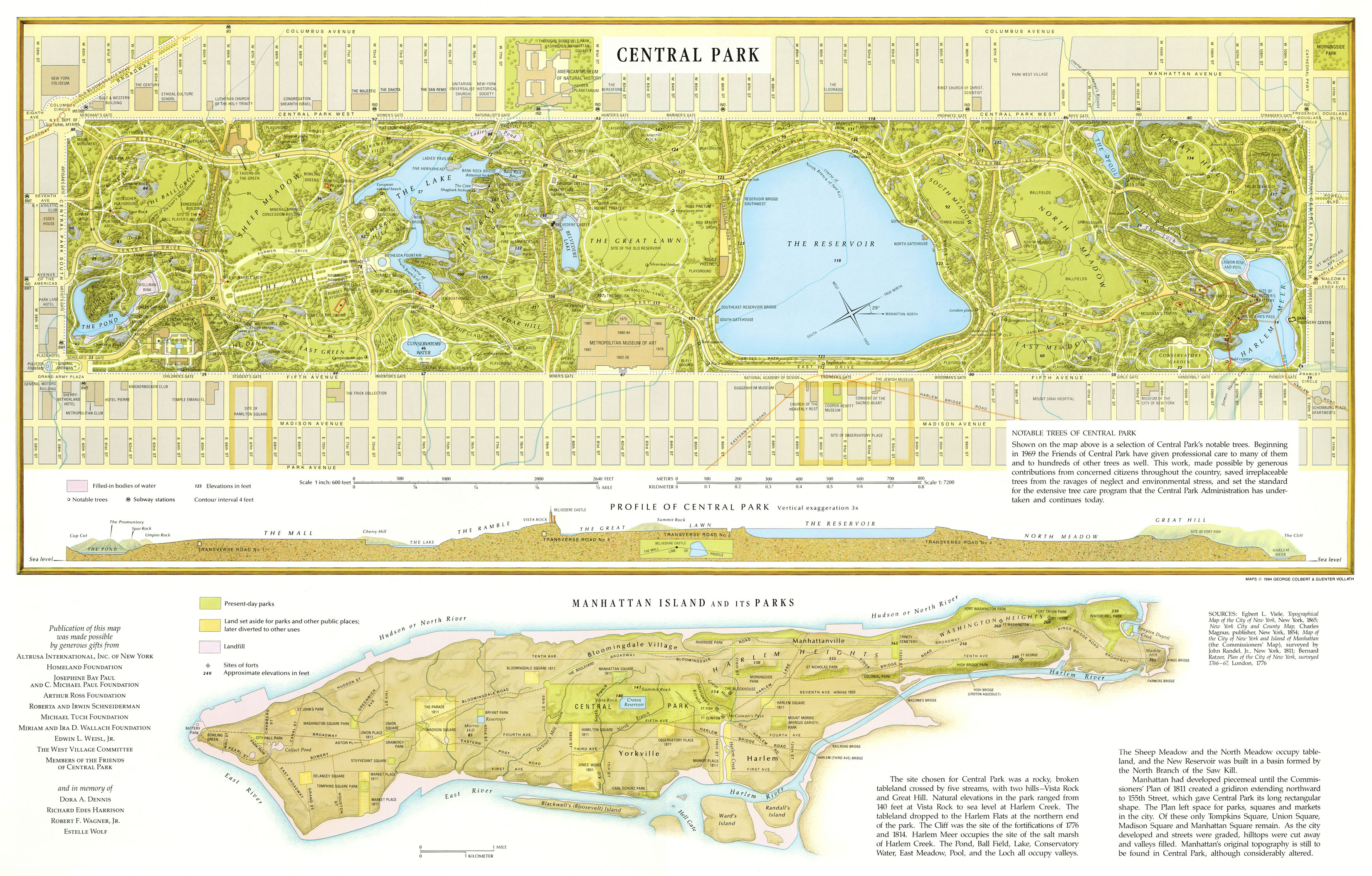
Header image: 1994 Greensward Foundation map of Central Park from this post here.


Having gone to undergraduate school at North Dakota State University in Fargo in the mid-1990s, one became aware of a distinct transitional zone as you headed east towards the Twin Cities.  A short drive across the Minnesota border, you could see what was the shoreline traces that marked a clear shift of geology and with some study, begin to piece together the story of the past millenia, involving a glacier, a lake, and the reason the Red River flows to the north.

A recent Ghosts of Minnesota post “A Minnesota beach where there is no water”  by Troy Larson, reminded me of this place and the influence the immense glacial Lake Agassiz on the landscape of the upper sections of the Plains, a lake formed at the end of the last ice age, some 8,000 to 14,000 years ago.

A map of the territory by Warren Upham, from the earth 19th Century shows the extent of the Lake, and as mentioned by Larson, “Today, Lake Agassiz is believed to have been even larger than what is represented on this map.”

Larson gives some context:

“Lake Agassiz was a massive body of fresh water in the middle of North America, larger than all of the Great Lakes combined. As the ice sheet retreated, ice dams held back the meltwater to create glacial Lake Agassiz. As the lake drained, sometimes slowly, other times in sudden, catastrophic outflows, the lake shrank and changed, leaving behind a table-flat landscape with some of the richest farmland in the world, and even sandy beaches from it’s ever-shifting shoreline. To the geologically educated, the signs of Lake Agassiz are everywhere, but even to those like myself, without a geologic eye, there are places where you can see the remains of this monster lake.”

A close up shows the area around the North Dakota-Minnesota border, bisected by the Red River (of the North).

The post covers some photos of the area near Fertile, Minnesota, home of the Sandhill Recreation Area and nearby Agassiz Dunes Natural Area, and as explained in the Ghosts of Minnesota post by Larson: “These dunes were formed as the ice sheet retreated and the weather became dry and hot. In wetter times, foliage appears and covers the dunes, and in dry periods, the growth retreats and the sand becomes more visible.”  With places like a dune called “Death Valley” named due to the instability of the shifting sands, this is an atypical plains landscape.

image – Ghosts of Minnesota

image – Ghosts of Minnesota

While there are plenty of lakes in Minnesota (yes, well over 10,000) the sort of expansive lake left traces of a more significant water body, as mentioned by Larson:

“The sand feels just like beach sand. It’s a soft, fine grain sand that shifts beneath your feet when you walk on it.” 

image – Ghosts of Minnesota

A more expansive map from a recent CBC article that covered a new book by Bill Redekop (@billredekop) entitled “Lake Agassiz: The Rise and Demise of the World’s Greatest Lake” exploring the hidden mystery of the lake.  “For millennia, the evidence of its existence remained hidden in plain sight, but slowly details of the landscape began to merge in the minds of people passing through the province.” The modern map (via the CBC article) shows a more expansive Lake Agassiz, and the extent:

As Redekop explains, the investigation of the hidden connects the modern to the historical.  He summarized the feeling after writing the book:

“”Now I have two landscapes: the one that I see and the one that I imagine, that I know was there 10,000 years ago.”

The deep time of geology, as mentioned here in the post on Seattle area, leaves many traces and clues to .  Beaches without lakes, valleys without creeks, all connect us to a historical past that shapes our present and future.

Header image of Lake Agassiz dunes – via Ghosts of Minnesota