Map-making is an inherently iterative process.  Often finding an appropriate base layer is vital to providing a solid foundation for this process. In this spirit, I’ve been working on the digitization of the basic Public Land Survey System (PLSS), or the Cadastral Map series for both Portland and Seattle from the 1850s as base maps for the hidden hydrology studies of both cities.  This data, which is the most uniform and complete snapshot of the landscape of the west, is a great resource for the locations of historic streams and other features.  Because the use of the shared cartography of Townships with their corresponding Section grids, the PLSS maps provides a link to very accurately georeference the historic with the modern.  Prior to diving into some of this work, I thought it prudent to discuss the Public Lands maps themselves.

There’s plenty of history out there for those in the mood, and my plan isn’t a deep dive, but more of some context.  A good starting place is ‘The National Map’ page by the USGS on the subject of the PLSS, and a brief history page from the BLM.  Everything else you may want to know about the Cadastral Survey is found at the Bureau of Land Management page of Tools, including the massive 1983 History of the Rectangular Survey System by C.A. White (46mb PDF).  The terminology of the PLSS, is somewhat synonymous with the concept of Cadastral Survey, although in reality there is a difference, as one (PLSS) is the thing itself mapping the United States, and the other (Cadastral) a type of survey, defined as “having to do with the boundaries of land parcels.”  Cadastral surveys of all types are done all over the world, and the origin comes from the “…Latin base term Cadastre referring to a registry of lands. So actually Cadastral Surveying is surveying having to do with determining and defining land ownership and boundaries” (via Cadastral Survey).  

After the Revolutionary War, there was huge amounts of available land, and the need to distribute and sell tracts became necessary for the new survey.  While the original colonies were laid out pre-PLSS using more traditional metes and bounds, but due to the immensity of the effort, Thomas Jefferson proposed a system of surveying massive open tracts of land. The Land Ordinance of 1785 set up the system and the subsequent 1787 Northwest Ordinance kick-started the process (although it referred to the areas NW of the colonies, not the actual NW Territories).

The surveying moved across the country over the next hundred years – as   The extent of the surveying is captured in the map below, starting in Ohio and Florida on the east and encompassing the majority of the midwest, plains, and west including Alaska (which is still being surveyed today), with the only exception being Texas.  Almost 1.5 billion acres were included.

Anyone who has looked at a survey will be familiar with the language of the PLSS.  Any legal land description could be generated starting with “…the State, Principal Meridian name, Township and Range designations with directions, and the section number”. There are many versions of this diagram out there, but it breaks down the foundations of the PLSS using the Principal Meridians and Base Lines, and breaking the grid into Townships and the 36 smaller Sections.

The markers are vital to maintaining the integrity of the grid over centuries, and there are approximately 2.6 million section corners across the US. An interesting link to the ‘Corner Identification and Markings’ shows some of the layout specifics and one of the common protection measures employed for the corner monuments, circling the monument in a circle of stone.  There is a shared geography continuity between the principal Willamette Meridian, established in 1851, with bisects both Portland and Seattle, and the shared baseline which runs parallel a bit south of the border between the two states.

In the Pacific Northwest, and there’s some reverence for the particular.  The Principal Meridian Project is pretty fun, and has some great photos of the Initial Point (the crossing of the Principal Meridian and the Base Line seen above), found in  Willamette Stone State Heritage Site in Portland.

“The Willamette Meridian was established June 4th, 1851 and runs from the Canadian border to the northern border of California. The base line runs from the Pacific Ocean to the Idaho border. All property in Washington and Oregon is referenced to this point.  The original stake was replaced by a large stone in 1855 and is now part of The Willamette Stone Park in Portland.”

The PLSS is still updated, so if you want a deep dive in this topic, you can reference, the 1973 Manual of Surveying Instructions , which provides the most current info on PLSS surveying.  Rather than a mere history lesson, the concept of the PLSS is vital to the understanding the ability to reference historical maps and .  This is less important for East Coast but for a large portion of the United States, is the vital tool for hidden hydrology work.  Also the extent of coverage that was all completed within a short timeframe (at least in local areas) provides a measure of comparability between areas.

A typical survey map shows the detail of the maps, in this case Township No. 1 N. Range No. 1 East, in the Willamette Meridian, with downtown Portland in the bottom of the map, and showing some of the topographic features, ponds, and streams.  IN this case, the original 1852 map was redrawn in the early 1900s, which is pretty common.  This info is downloadable via the BLM site.

And the typical surveyor notes, which are a tough read, but shows the information which was later interpreted by the mapmakers, based on the surveyors notations as they followed the specific section lines within the individual townships.  The interpretation is a key item that implies the ‘filling in the blanks’ of these maps, as each line was not individually surveyed.

To see this in action, and to explain the correlation between georeferenced history maps and the modern GIS, you see the rectangular areas of the map Sections (this map is a composite of the map above (T01sn01e) and the Township below (T01s01e).  This is the area in the Taggart neighborhood, in this case the upper Taggart Basin, showing the Willamette River (light blue), some small water bodies and streams (darker blue), as well as riparian wetlands (green).

The same area is georeferenced with modern GIS info (in this case the 2010 roads, parks, schools), and you can see the Section Lines (orange) that register on maps.  The Taggart streams have long been buried, along with the filling of the wetlands along the Willamette for industrial lands.  The modern topography is also shown, and you can see the tracings of the landscape channels still evident today.

The ability to tap into other map tools, in this case digital elevation ‘hillshade’ model (of the Lower Taggart Basin) again give some context for new and old, and graphically show some of the landform that exists today.  There’s no shortage of analysis once the PLSS info is referenced.  Lots more specific info on these maps in Portland and Seattle coming soon.

While amazingly detailed, the maps are, as mentioned, somewhat variable in nature due to the interpretation of survey notes and mapmaking.  Thus, the PLSS becomes a great starting point, with good coverage and georeferencing, some they become a framework for overlaying other maps and data.  Also, while the surveying standards were the same, as I will point out in a future posts, the quality and legibility of the maps often depended on the mapmakers themselves, and maps of one location could have very different information.  This is evident from looking at Seattle versus Portland, and what i feel is a specific quality of maps in the latter versus the former.


Endnote:  Having grown up in North Dakota, I was very aware both of the grid, and the ubiquitous grid-shift – as the rhythm of gravel roads cut through the state if perhaps more evident and legible when each ‘back road’ follows a grid.  The excerpt below from Fathom shows the amount of contiguous one miles squares.

This making it infinitely possible to chart one’s path multiple ways to get to locations, and also comes with long stretches of arrow-straight road ending with a curve or more often a tee.  Many a speeding or slightly inebriated driver was been surprised by this phenomenon.   This comes up perusing such Instagram accounts like The Jefferson Grid, and for me more recently someone linked to re-posted from an article in Hyperallergic, featuring work of artist Gerco de Ruijter from 2015, as he masterfully documents this using a series of Google Earth images.

From his site:

“By superimposing a rectangular grid on the earth surface, a grid built from exact square miles, the spherical deviations have to be fixed. After all, the grid has only two dimensions.  The north-south boundaries in the grid are on the lines of longitude, which converge to the north. The roads that follow these boundaries must dogleg every twenty-four miles to counter the diminishing distances: Grid Corrections”

For more on this, check out Geoff Manaugh’s post from a few years back and his longer article in Travel & Leisure magazine.  And for a bit of bonus, check out Gerco de Ruijter short video ‘Grid Corrections’ (i prefer with the sound off, but let me know).

Grid Corrections (a one minute) from Gerco de Ruijter on Vimeo.

HEADER IMAGE:  Archival Photo of Surveyor – via BLM

The recent post Aquae Urbis Romae discussed the Waters of Rome project by Katherine Rinne.  As mentioned, the map referenced most heavily in her work is the 1551 Bufalini map, which shows conceptual topography and figure ground relationship. Like anything, once you dive into the maps of a particular area, especially one with the history, you can quickly fall down the rabbit hole.  So dive in.

A great article from The Metropolitan Museum of Art, Antonio Tempesta’s View of Rome: Portraying the Baroque Splendor of the Eternal City links to a number of maps that were created as part of a 2012 Bernini show.  Chronologically, this Nicolas Beatrizet engraving from 1557 is around the same time frame as the Bufalini map, but simplified, with some interesting graphic style and axonometric illustrations:

A more aerial version of this perspective from the west in 1590 is found in the Speculum Romanae Magnificentiae: View of Modern Rome from the West by Giovanni Ambrogio Brambilla.

The map perspective ‘Plan of the City of Rome’ from Antonio Tempesta is from 1645 but was first printed in 1593 around the same time as the Brambilla map, bust showing the view from the northwest.

The maps as a whole is broken into twelve tiles, so zooming in on an individual view shows the richness of the illustration.

Taking a similar view from the Northwest as the Tempesta map, Matthuas Merian’s 1642 Topographia Germaniae printed a color version, showing the view in 1641, and definitely highlights how the use of color can change the nature of a map.

Coming 200 years after Bufalini, the (argubly) most famous map of Rome is one of my favorites, the 1748 Map ‘Grande Pianta‘ by Giambattista Nolli (more commonly known as the Nolli map).  This work of art is infamous for its detail and being the precursor of the expanded ‘figure-ground’ diagram many of us use today.

Nolli Map – via visual.ly

A set of high-resolution tiles from UC Berkeley allows for zooming in to the beauty of the map, the gradations and the figure-ground representation.

The idea of the interior public spaces as ‘void’ on the map is worth a close-up, as you can see above a bit, but it’s easier to read here, where you can see the plaza spaces (bottom of Piazza Navona on the upper left) versus the interior spaces such as the circular Pantheon and the structure of local churches:

And I love the way some of the gardens are represented, which gives a somewhat different feel from plaza spaces – sort of creating a spatial hierarchy and network of green spaces.

After searching, I found the term for the illustrative border, not sure if that’s the cartographic term, but the veduta ‘italian for view’ is typically a cityscape.  The one the Nolli map illustration was done by Stefano Pozzi.

There are some other high resolution version of this as well, and if you have the means, they can be purchased here, here and here.

For the interactive options, a project of University of Oregon spawned an online interactive version of the Nolli Map:  “The Nolli website presents the 1748 Nolli Map of Rome as a dynamic, interactive, hands-on tool in both written and graphical form. The map not only provides rich information, but it has the ability to be updated with new data over time to embrace expanding knowledge.”  The viewer is ok, and the thematic symbols are interesting, but resolution is a bit too small, objects aren’t clickable and the interface is somewhat hard to navigate.  

For some other options, there’s an OS app as and another digital version from B-Open Solutions which is a simple georectified copy overlaid on the modern map, allowing for easy zoom, multiple underlays, and opacity shift to see the before and after (which amazingly is not that different – owing to the quality of Nolli’s map-making).  It also includes the ability to click on the original legend for Nolli’s map.


The Nolli map is the touchstone of modern mapping in Rome. In the mid 1800s, for some reason, an almost exact copy of the Nolli map by Paul-Marie Letarouilly. A clickable version of a tourist map based on the 1852 map is the basis for a clickable map of info by Rome Art Lover, which has some good info (lurking within a mid-90s website style).  More interesting is his precursor, which is also based on Nolli, the  1849 Plan de Rome Moderne au tiers de celui de Nolli which acknowledges the original.

Detail shows the homage to the interior public spaces from Nolli, and something about the sparseness of linework (albeit a copy) makes this a beautiful addition to the map library .

CODA: DEEP HISTORY

As I emerge from the rabbit hole, it reminds me of the rich history of mapping, and the skill of the mapmakers in the absence of modern tools.  While this is not about hidden hydrology per se, the map as a tool, inspiration, and guide is a thread that permeates mine and others interest, and the concept of multiple maps documenting ‘long’ history is impressive.   In that spirit (inspirations and rabbit holes) one must go even farther back, and visit the Stanford Digital Forma Urbis Romae Project, which documents the Severan Marble Plan of Rome.  Be forewarned, you can lose yourself in this one.  Some background:

“This enormous map, measuring ca. 18.10 x 13 meters (ca. 60 x 43 feet), was carved between 203-211 CE and covered an entire wall inside the Templum Pacis in Rome. It depicted the groundplan of every architectural feature in the ancient city, from large public monuments to small shops, rooms, and even staircases”

There are available a little over 1000 fragments, many with few marks and some painting the rich historical story of the map.

To give an indication of the immensity of the effort, some more from the site, “The Severan Marble Plan is a key resource for the study of ancient Rome, but only 10-15% of the map survives, broken into 1,186 pieces. For centuries, scholars have tried to match the fragments and reconstruct this great puzzle, but progress is slow–the marble pieces are heavy, unwieldy, and not easily accessible. Now, computer scientists and archaeologists at Stanford are employing digital technologies to try to reconstruct the map.” 

Save

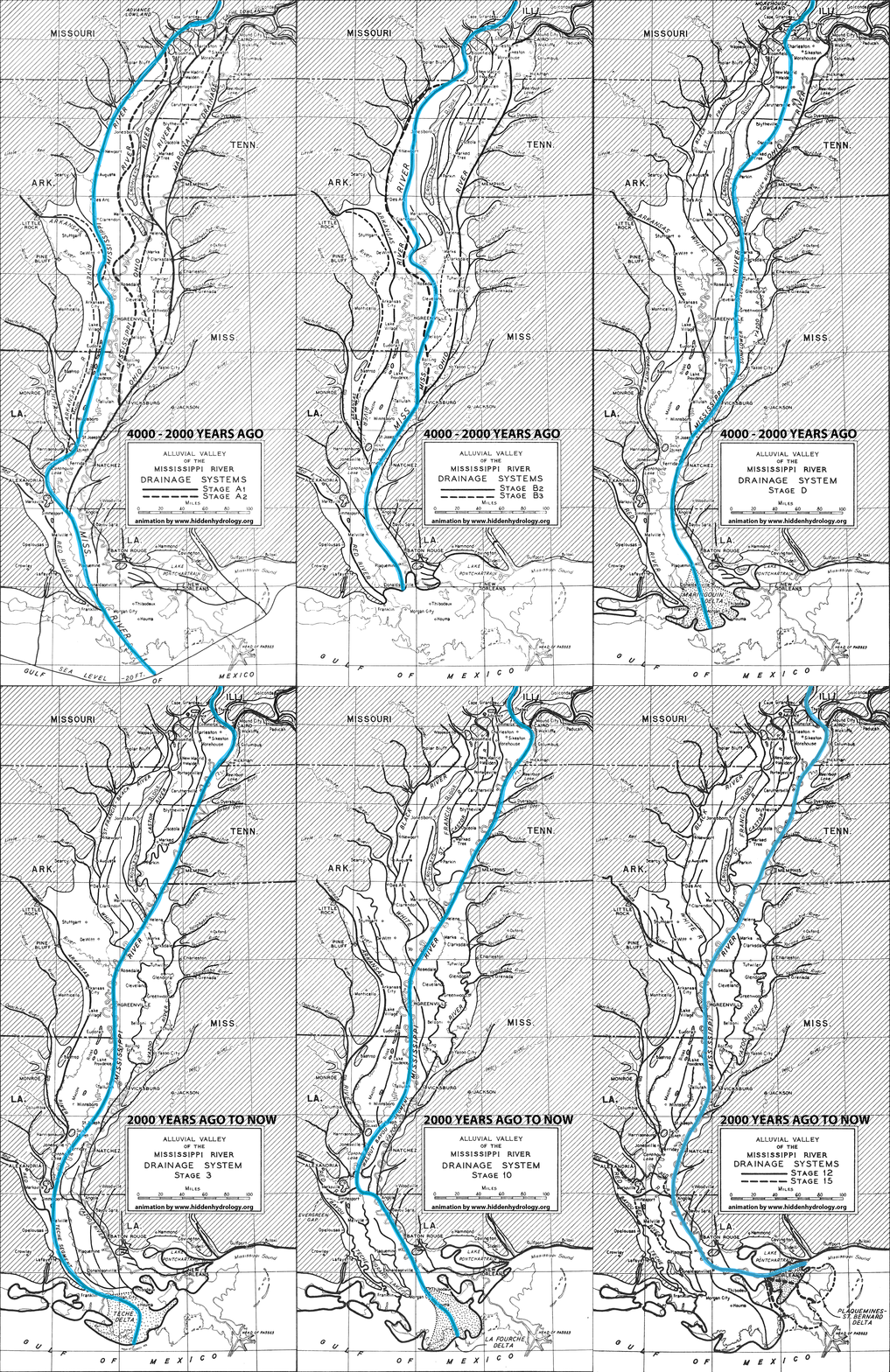
From the recent post, Indeterminate Rivers the Geological Investigation of the Alluvial Valley of the Lower Mississippi River by Harold N. Fisk offers a wealth of information on landscape change.  When I first saw the series of maps the idea of showing the shifting path of the river came to mind – and I envision a much more intensive and animated idea could be applied to the color map series (from the original post) to illuminate not just the static traces but the actions of this hidden hydrology over time.

The simple animation below is based on the maps in the report that discuss the formation of the valley and the current configuration of the meanders.  For reference, this map isn’t an attempt to make  conclusions, but to activate some of the data represented in 2-D format in the report – showing the breadth of change of the main path of the Mississippi over the course of 4000 years of change.

More explanation of the specifics found at the page ‘Mississippi River Change’.

Save

Save

The concept of history is relative. Living in the Pacific Northwest in the United States, a span of a few hundred years constitutes the sum of contemporary settlement and European colonization (with some exceptions). Many contemporary cities such as Seattle and Portland, for instance, were only formally settled in the 1850s, are were not urbanized for decades after, resulting in relatively short histories. Obviously these lands were populated for years previously by indigenous peoples, some with formal and informal settlements, however, either way, the modern urban form is young.

The eastern US has a slightly longer history, but even New York’s history of European settlement dates around 1600, so around four-hundred plus years.  Many places in the world have a much different story and measure history is very different terms.  Rome, for instance, offers a different scale of time, much deeper picture of history spanning millennia.  Depending on who you consult, Rome was a village since the 9th Century BC and became a city around 753 BC, so has been evolving for almost 3,000 years.  In much of this span “The Roman empire stretched over three continents, had 70 million people, and had a logistics and infrastructure system that kept them going for centuries.”  (via Science 2.0)

A great site to explore this immense history with a unique focus on water is Aquae Urbis Romae: The Waters of the City of Rome – a long-term project of Katherine Wentworth Rinne from 1998 to present, which is published by the Institute for Advanced Technology in the Humanities from University of Virginia.

A summary:  “Aquae Urbis Romae is an interactive cartographic history of the relationships between hydrological and hydraulic systems and their impact on the urban development of Rome, Italy. Our study begins in 753 BC and will ultimately extend to the present day. We examine the intersections between natural  systems–springs, rain, streams, marshes, and the Tiber River–and constructed systems including aqueducts, fountains, sewers, bridges, conduits, etc., that together create the water infrastructure of Rome.”

The site has a ton of information, especially great for an Italophile such as myself.  The content is organized into a few categories, some of which are for archival purposes as their web presence is not longer functional, but there is info organized as a timeline (including a GIS Timeline Map), as well as by typology, and studies of topography.  There are maps and a list of resources and some good primary and secondart texts available.  The journal “The Waters of Rome” offers ten essays with some additional scholarship on Rome history and culture around water.  I’ve yet to dive in depth into these, but look forward to it.

For hidden hydrology perspective, the Timeline features the ability to isolate typologies that allow focused look at systems.   A section of maps on Hydrological Setting, shows the hidden streams overlaid on modern (c. 1998) city grid and topography.  “This map represents a composite of data drawn from archaeological, geological, historical, and literary evidence concerning the hydrological structure of the intramural city and its immediate surroundings. It does not represent a specific point in time, but rather represents an amalgam of hydrological features, most of which have been known since antiquity. However, water is dynamic and therefore constantly changing. Springs can disappear, dry up entirely, or reemerge at a different, sometimes distant location. Streams and rivers can change course, and the profiles of their beds are constantly changing as well.”

This information is activated by translation into three-dimensional views in the Topography section, providing some more info on the landform that relates to historical streams.  They are developed thematically as well, with a number of studies such as hydrology and aqueducts serving the baths and fountains in the city.

Today this is somewhat simplistic in terms of graphics. In 1998, this would have been pretty cutting edge stuff.  Similarly, the GIS Timeline map offers both spatial and temporal info in a more interactive format, with the ability to customize.  This is the best info I’ve found on historical hydrology of Rome, via the Geographic features typology that include Marshes, Swamps, Rivers, Streams, and Springs, a few of which are plotted below.

The focus is on water, but not just streams, there’s a range of other typologies, including water distribution, infrastructure, flooding, markets, walls, neighborhoods (rione), baths, fountains, and more.  The icon based map allows for more info via pop-ups.

A legend shows the span on types of info captured, along translation of English and Italian terms.

The temporal aspect is a interesting idea, as it allows a fourth dimension to the mapping that seems vital to historical study. The slider (seen below) allows for all years to be selected, or to select individual decades, and eras, to capture snapshots of info at certain time frames.  As mentioned on the site: “Follow the urban development of Rome through a unique G.I.S. timeline map that chronicles changes to the water infrastructure system from 753 BC through the sixteenth century. See how sewers, aqueducts, fountains and other hydraulic elements changed the face of Rome, as important people like Agrippa, Emperor Nero and popes Sixtus V and Clement VIII, among others, used water as an element of political control.”

This obviously works better for cultural features like buildings and fountains that have specific dates of creation and erasure, so not sure if it captures erasure of surface streams into subsurface routes.  However, with enough information, you could show the disappearance over time for any water system and include animations at a time step (similar to this historical study of the Mississippi River gleaned from the Fisk maps).  Something worthy of exploring with current GIS and animation technologies.

The site is plagued with some old technology in terms of web design (frames, for instance, which are awful for navigation), as well as the mapping and animations discussed above. This is tough, as its always hard to keep things up to date.  Over time, something using the most recent tech quickly becomes outdated, especially on a project that spans decades such as this.  That said, the content holds up very well, and some easy fixes would be to remove some of the clunky old maps and convert these to simpler embedded open source interfaces (Google Earth, etc) – as well as to be able to download GIS files of some of the key info. Sounds like from some of the notes, there’s some updates in the works, so look forward to reaching out to Ms. Rinne and see what she has planned.

The idea of deep history in tied closely with the maps, and the long history of mapping Rome is a fascinating rabbit hole to dive into.  The site offers a link to many Print, Drawing, Map and Photographic collections of Rome, where you will find the the key source in this exploration, the map ‘Roma’ by Leonardo Bufalini in 1551, which shows a somewhat developed city plan along with rudimentary topography and hydrology from almost 600 years ago.

The site offers each of the tiles of the map, (noted: Courtesy of Kersu Dalal, Johnson Fain Partners, Los Angeles).  This shows a lot of amazing detail, and hints at slopes and ridges and depressions that impact water movement.

A figure from the 1897 publication “The ruins and excavations of ancient Rome” by Rodolfo Lanciani shows the ‘Hydrography & Chorography of Anicient Rome’, capturing many of the streams and marshes shown on other maps.

And zooming about a bit, showing the broader area of “The Tiber & Its Tributaries” by Strother Smith from 1877.

The most famous map of Rome is one of my favorites, not mentioned much on this site, but well known.  Almost 200 years after the Buffalini map, the 1748 Map ‘Grande Pianta‘ by Giambattista Nolli (more commonly known as the Nolli map).  This work of art is infamous for it’s detail and unique showcasing of public/private spaces inside and outside of buildings, versus pure figure-ground relationships.  I’ll discuss this map and a few others from Rome in a follow-up post.

Nolli Map – via visual.ly

Images on this post from the site Aquae Urbis Romae: The Waters of the City of Rome unless otherwise noted.
Header image: Castel San’t Angelo from the South, painted in the 1690s by Caspar Andriaans van Wittel

The recent post about the Mississippi River change illustrated in the Fisk maps reminded me of this lovely lidar image of the Willamette River, which encompasses the region around Portland, Oregon and south.  The image Willamette River Historical Stream Channels, Oregon, 17 x 38 inches, by Daniel E. Coe (via the State of Oregon Department of Geology and Mineral Industries – DOGAMI).  From their site:

This lidar-derived digital elevation model of the Willamette River displays a 50-foot elevation range, from low elevations (displayed in white) fading to higher elevations (displayed in dark blue). This visually replaces the relatively flat landscape of the valley floor with vivid historical channels, showing the dynamic movements the river has made in recent millennia. This segment of the Willamette River flows past Albany near the bottom of the image northward to the communities of Monmouth and Independence at the top. Near the center, the Luckiamute River flows into the Willamette from the left, and the Santiam River flows in from the right. Lidar imagery by Daniel E. Coe.”

Via an article in the Oregonian, the utility of LIDAR in evaluating subtle changes that wouldn’t be visible via aerial photography is evident, and the “Lidar data is collected by low-, slow-flying aircraft with equipment that shoots millions of laser points to the ground. When the data is studied, an amazingly accurate model of the ground can be mapped.  It is possible to strip buildings and vegetation from the images, so that only the ground is shown. In the Willamette River poster, the shades of white and blue show elevations. The purest white color is the baseline, (the zero point, at the lowest point near Independence on the upper part of the image). The darkest blue is 50 feet (or higher) than the baseline.  The shades of white show changes in elevation, between 0 to 50 feet. This brings out the changes made by the river channel in the last 12,000 to 15,000 years, in the time since the landscape was basically swept clean by the Missoula floods.”

The evocative image that is fluid and abstracted, as mentioned in the Oregonian article by the mapmaker, Dan Coe:

“The different movements of the river make the image take a liquid shape, even almost like a cloud of smoke. This shows the magic of lidar.”

You can download high resolution PDF of this map (52.3 MB) from the site for printing.  As an added bonus, their site offers a number of interesting Oregon maps for download, including this oblique view of the Willamette River in postcard and poster formats.

Save

Save

Save

The concept of indeterminacy is built into any study of hydrology, whether contemporary or historical.  Rivers, creeks, streams are in constant, dynamic flux with varying levels of human influence from relatively pristine to the buried, channeled and culverted forms that are often our focus on this site.  The term, obviously means ‘not determinate’, but elaborating somewhat in simple terms via Webster, is “not precisely fixed in extent; indefinite; uncertain” or via the OEDNot exactly known, established, or defined“. 

The idea of looking at historical maps to unlock the stories embedded is further complicated by this variation of time, as maps represent a fixed point in time but are not a specific known entity.  This happens in many cycles, including daily, tidal, and also seasonal variations, but over time, this accumulated energy creates meanders that snake across the floodplains driven only by hydraulic rules and adjacent land characteristics.  Less dynamic rivers or streams may maintain fidelity over time, while highly dynamic streams can move.

There have been some interesting aerial versions of stream change via the recently launched Google Timelapse, however, my go-to for visualizing indeterminate river are the Harold N. Fisk’s 1944 study of Geological Investigation of the Alluvial Valley of the Lower Mississippi River.  Fisk was a Professor of Geology at Louisiana State University. Known as the Fisk Maps, these made the rounds of landscape and mapping blogs over the past decade, blowing people away with both their complexity and artistry.

The ability to use two-dimensional graphic techniques to represent temporal change is the subject of much discussion in visualization and landscape urbanism circles, to name a few, and these maps are often held up as positive examples of showing dynamic processes.  A wealth of information is found on the US Army Corps of Engineers’ site for the Lower Mississippi Valley Engineering Geology Mapping Program including the full report, large format.  [Note: these files are large so I’m not directly linking to the zip files direct – so follow the link above]

The expanse of the Lower Mississippi alluvial valley drainage shows how much movement the river on it’s 600 mile journey through the Central Gulf Coastal Plan from southern Missouri to the Gulf of Mexico a massive delta landscape that has been massively altered by natural and human processes for decades, showing that even with our technological advances, the river often still doesn’t obey our wishes.  [Aside: For some great reading on this, check out McPhee’s ‘The Control of Nature’, one of the best on the topic]

The idea of dynamism is key and the study of this change over time offers an interesting dilemma.  The ever changing paths of meanders are able to be mapped in modern times, but previous paths require understanding geologic cues to trace that which had not been mapped.  The black and white maps show the overlay of dashed meanders with aerial photography, which in the mid 1940s, was not new, but was still a relatively nascent planning technology, albeit rapidly expanding due to advances in World War II.   It will be interested now with accessible tools like Google Earth and the constant documentation of detailed aerial and satellite imagery to see how a study like this would be done today.  This map below is one of the figures in Fisk’s report, showing dramatic changes of a section of the river at a historic ‘Diversion Point’

The main report has predominately black-and-white imagery, probably due to reproduction costs in the 40s, but they still hold up.  Any who has read a geotechnical report knows many of the techniques for representation of borings and soil strata know they can sometimes be a bit try and technical.  This report is somewhat dense (and to be honest I’ve only skimmed some parts) but the visuals are so compelling.

Large, multi-page pull outs of regional geologic sections remind me of the early figures of von Humboldt, which contrary to more modern interpretations had a certain life to them.

Even the meander diagrams (in this case showing uses of clay plugs to control river bend migrations) are pretty cool in black and white.

Similarly, detail diagrams of braided stream topography and floodplain deposition are works of art, while also attempting to communicate immense amounts of technical information.

My hidden gem here is this graphic table of Geologic Time which traces Eras base a billion years and overlays the idea of big time with the relative amount of our recent human history.  I’m pretty sure I’ve seen this reproduced in modern geotech reports, or somewhere, but there’s something about serious report containing imagery of cave-people and dinosaurs to put the breadth of time in perspective.

Anyone who’s attempted to communicate using black and white figures knows they are tough to pull off graphically.  The above examples show that there’s a lot of information that can be conveyed in simple linework and that it doesn’t need to feel static.  That said, the beauty of the Fisk maps are the dynamic color plates, easily highlighting change and dynamic processes. A representive full map below shows the interplay of linework, hatching and color to bring the technical information to life.

A close up of a different map, showing the immense amount of information in meanders, oxbows, eddies, and the extensive floodplain of this massive river system.

The legend shows the color coding scheme based on when the rivers were mapped (solid) and those dervied from clues via aerial photograph analysis (hatches).

The entirety of the set of meander maps (that were rectified) has been stitched together – and is sort of incredible, via a Nerdist post from 2014.  I’d love to print out these full size and display somewhere.

These meander maps are a next iteration of earlier mapping, derived from a series of Stream Channel maps from 1939 (also available via the LMV Mapping page) that show the most recent survey work (when I say recent I mean 1700s to early 1900s.  It’s  still impressive (and a bit simplified) to see the amount of channel change.  Not sure if Fisk was involved in these maps, as they predated his involvement in the final report, but there’s similarities in graphic style and content.

While the maps of the meanders get much of press, I’m also a big fan of the Stream Courses (these are also part of the Fisk report, downloadable as plates via LMV Mapping page) which are larger maps showing multiple, color-coded maps of stream change over the past 2-3000 years.  One of the maps below shows a section of the main step and remainder of the valley.

The key gives some idea of the way time is juxtaposed spatially on the map.

You can pinpoint the specific stream courses and alluvium in an enlargement, telling another complex story of river movement.

The reports and links abound with interesting information, such as the Entrenched Valley System, which delineates a dendritic network which contains the main channels and tributaries of the Lower Mississippi basin.  This visual technique is somewhat more topographic, hinting at the tracery of valley to upland and basin shape that would be visible, and perhaps offered some resistance to channel migration over time.

This entrenched valley structure is shown in larger context, as the main stem outfall potentially being directed towards a real hidden river – a “submarine canyon” in the Gulf of Mexico.  I’d be curious if that is the actual hydrology based on our current knowledge, but I’d not thought of subsurface hydrological flow influencing river systems (although in retrospect it makes perfect sense).

Some other interesting maps that tie in basin and river specific info are accessed via main LMV Mapping page.  These show geological investigations and Alluvial Deposits throughout all of the basins.  Clicking on a basin will get you to specific 15 minute quadrangle maps, selectable within the study area.

The maps show distribution of alluvial deposits, which is less about channelization than the overall reach of the floodplain hydrology.  The difference between low-lying Baton Rouge, for instance with a wide flat deposits.

… contrasted with a more northern location, Caruthersville, Missouri which shows a long series of bends and oxbows left over time.

I also love the annotated sections showing strata via geological investigation, in this figure for Caruthersville highlighting predominate soil types.

SUMMARY

As mentioned, the idea of indeterminacy is writ large in the study of hidden hydrology as it connects historical ecology to the modern metropolis.  History is a series of touchstones over time, and the information we have is always incomplete, requiring us to interpret the data points we have and make inferences to that which exists in the gaps of knowledge.  If we are to use the historical maps and sources we must understand this process (and perils and pitfalls) and be respectful of what we know and that which we can never know. Indeterminacy, as with life, is the heart of these explorations.

The work of Fisk on these maps is also a great example of looking back in time at a dynamic system and unlocking the story in visual terms.  The visualization challenges can be addressed in a number of ways, and technologies of visualization exist today that our predecessors didn’t have, but also show that we don’t need to rely on too much technology to tell a vibrant story – a pen and paper, perhaps some color, as proven above, can tell many tales.


Save

Save