
A great kickoff lecture to the Waterlines class at the Burke Museum featured noted regional geologist and retired UW Professor Dr. Stan Chernicoff and his exploration of The Origins of Seattle’s Landscape. Having read a bit about the local geology over the years, and having experienced some specifics (particularly the glacial till in Seattle) in my work, I had a rudimentary understanding of the general picture in our region. Thanks to this lecture, and the philosophy that ‘dynamism is key and change is inevitable’ espoused by Chernicoff, I know a lot more and think about the region in new ways. From his lecture, I found some interesting links between the larger and longer scales of geologic time and it’s relevance to the Hidden Hydrology project.
His lecture loosely focused around the concept of changing Waterlines around the region, and organized his talk to be roughly chronological and covered a lot of ground – from 1.1 billion years into the past to 250 million years into the future. Much of the beginning conversation was looking back at the time when Seattle was not coastal but inland as part of the Rodinian Supercontinent (one of the pre-Pangean configurations) and the coastal accretion of lands from the final supercontinent (where to coast was originally at the MT/ID border), and the lands that were added over the past 150 million years (Okanogan Mountains, Cascade Mountains, San Juan Mountains and most recently the Olympia Mountains) through lands being drawn in through subduction. This means that Washington and Oregon are mere infants in the larger timescale, as Chernicoff mentions, compared with the larger geological history. The key diagram he showed here is the overlapping sections of the subduction zone in the Juan de Fuca plate and the location of between the Olympics and the Cascade Mountains, with the layers levels and timelines of geological traces over the past 50 million years..

The bit of trivia that Seattle is sitting atop the Olympic Mountains – as you can see by drawing a line through to the Crescent Basalts below us. The evolution from the last 40 million years in shaping the zone, through Volcanic mudflows (yeah, there was a volcano called Mt. Seattle somewhere near Issaquah) that left lahars 40 million years ago. This was followed by periods of inundation, and when the land was warm and swampy, which left the deposits of coal near Renton (an interesting Puget Sounds coal history where we ended up shipping to San Francisco). The marine heritage is also found in the prevalent Blakeley formation, which evolved from a shallow marine estuary from submarine landscape deposits 30 million years ago – and today one can still find fossil shells around many places in the Puget Sound.
There are some interesting facts that illuminate this history and dynamic story of change. First, while the larger geology set the stage and influences the form, the current lakes, and rivers were a product of the latest glacial period, which Cordilleran Ice Sheet covered the area and the Puget Lobe formed the shape of the current region. The glacier was around 3000 feet thick, which pushed the sound down almost 1000 feet, and created the depression that allowed water to flow in and formed the modern position of waters.

The rule of thumb is the thickness of depression will be 1/3 the thickness of the glacier.  An interesting section (see right) showing how this cap of ice carved out Puget Sound nestled between the Olympic and Cascade Ranges – with linear scoured channels forming Hood Canal, Puget Sound, Lake Washington, Lake Sammamish, and created the terrains which Seattle occupied. These were all relatively north-south oriented which coincides with the intrusion and recession of the Puget Lobe. It is amazing to think of the larger glaciers in the Midwest, such as Minnesota, which were 3 miles thick and the impacts on that landscape, which for my knowledge, creates the rarity of the north-flowing Red River through where I went to college in Fargo, but also created the over 10,000 lakes that dot the region.
Second, is that because of the glaciation and recession, most of the hills in Seattle are glacial drumlins, (with the exception of West Seattle and Magnolia which are drift uplands). These hills were deposited upon glacial retreat, which gives them a distinctive steep north side and smoother south side, with alignment north-south as well as the long side corresponds to the direction of ice flow.

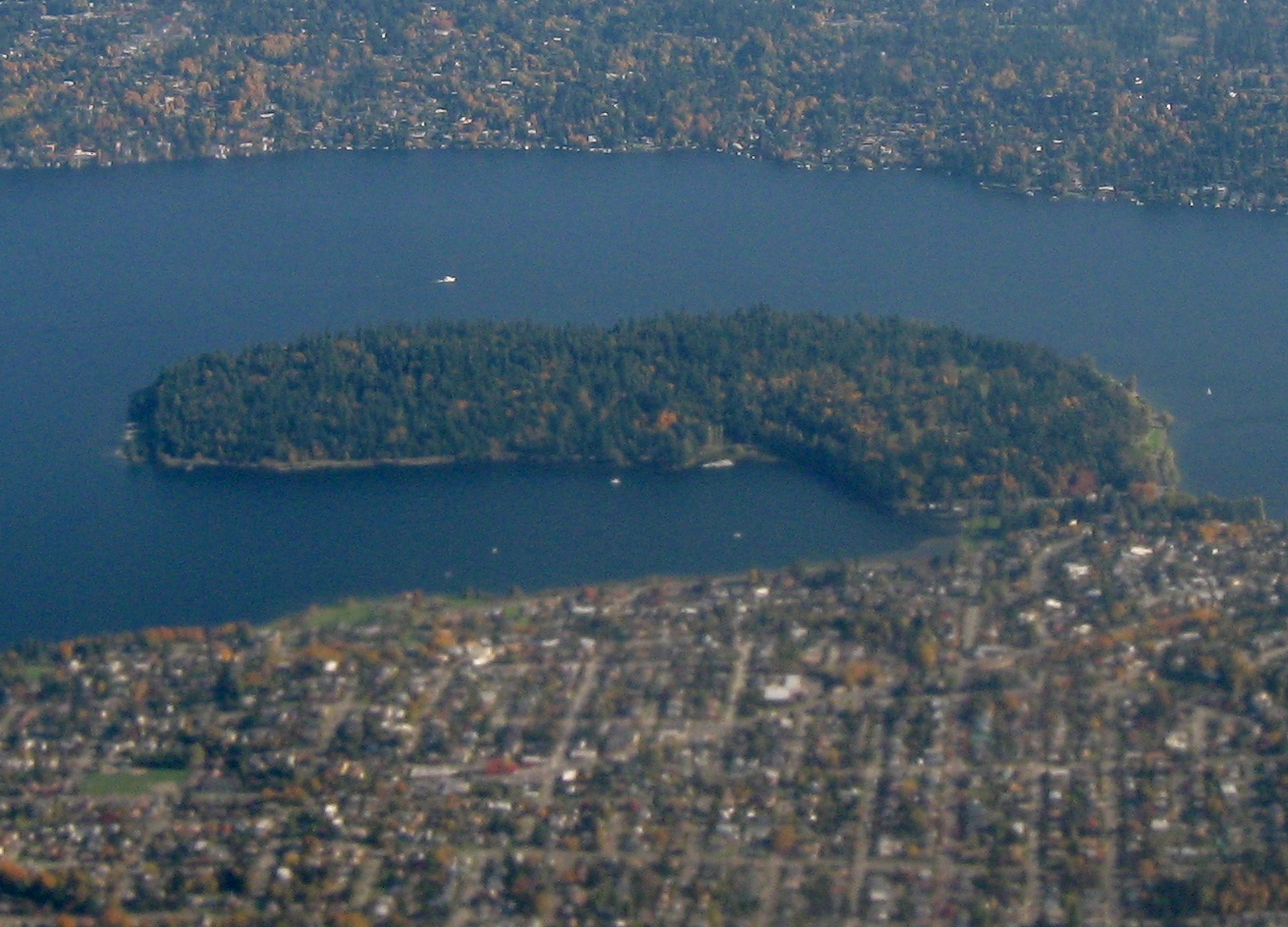
You see this in the larger hills in Seattle, as well as the creation of the individual creeks that are woven throughout the north section of the city. The topography carved these smaller drumlin shapes with drainages forming in the spaces at edges adjacent to lakes or between two hills. This formed unique geologic features like like Seward Park in the south section of Lake Washington.
A shapshot of the 1894 USGS Topo map shows the formation on Queen Anne (left) and Capitol Hill (right) with the steeper north edges, along with what is still showing the remnants of Denny Hill south before it and other topographic features were removed from the downtown area.

Third, the two smaller lakes in North Seattle, Bitter Lake and Haller Lake, are true kettle lakes, formed with glacial retreat. A hybrid of this is Green Lake, which also formed in the glacial retreat along with Lake Union and Lake Washington. Fourth, the glacial movement left a trail of glacial erratics all over the area, and I learned about one of the largest, the Wedgwood Rock, which originally was from miles north and now sits in NE Seattle. Definitely worth a field trip in the near future.

Fifth, the glacial deposition led to a preponderance of landslides, both with steep slopes, along with the layers of permeable Esperance Sand sitting atop a layer of Lawton Clay, which causes water to flow under the sand and create a slip zone (shown on right side of diagram below).
 This is exacerbated by the copious winter rainfalls, which exacerbates the issue via critical liquifaction zones, which means “…a phenomenon whereby a saturated or partially saturated soil substantially loses strength and stiffness in response to an applied stress, usually earthquake shaking or other sudden change in stress condition, causing it to behave like a liquid.” Thus the landslides and earthquakes have shaped the hydrology over time, as valley configurations shift with deposition from streams but also are influenced by these disturbance regimes.

The Magnolia Neighborhood is one of those areas where it has overlapped with the danger of building on steep/unstable slopes, as shown here in a wikipedia image of a slide in 1954 on Perkins Lane, a relatively frequent occurrence in Seattle in particular areas over the years. Chernicoff’s hint: Don’t by a house there.

The final part of Chernicoff’s talk focused on the ‘Rise and Fall of Seattle’, with a theme that in our dynamic and ever-changing landscape, “we can’t get accustomed to where water is”. He mentions four factors that will influence the geology of Seattle, including Local Geology, Regional Tectonic Factors, Regional Isostatic Factors (i.e. glacial rebound), and Global Eustatic factors (i.e. sea level rise). This was interesting, as the local conditions were all creating conditions that led to raising lands and lower levels of water. For instance, the two local geological factors were river sedimentation and landslides, both of which add land particularly at the deltas of larger rivers, such as the Skagit and Nisqually Rivers. As Chernicoff put it, through those two factors, the entire Puget Sound is trying to fill itself in. The regional factors of tectonic activity are at work, with quakes occurring regularly, which can instantly change the shape of our landscape through an earthquake. A slower mechanism continues to shift land with raising land due to glacial rebound, bouncing slowly back from being compressed by glaciers thousands of years back.
Inevitably, for all the minor modifications of local and regional factors, the larger impact is, wait for it… yep, global change, in particular the shifts associated with climate change. The melting of remnant ice sheets in Greenland and Antarctica, warming causing the thermal expansion of water combined to create higher levels, and lead to massive impacts on the waterlines of Seattle and everywhere else. He showed as an example a slide of the map Islands of Seattle, a great project by Jeffrey Lin (inspired by the original Burrito Justice San Francisco Archipelago map.) which hypothesized on melting of all global ice, including the Antarctic, which would result in a 240′ rise in sea level, creating a very dramatic new waterline and hydrology for the City.

For Chernicoff, it wasn’t a question of whether this would this happen or not. His geologists time lens is long and he knows there will be large-scale global shifts. The question is yes, however, does the time scale of this inundation take 30 years, 500 years, 10000? It’s an interesting juxtaposition of of deep, long geological time coupled with the dangerous (but possibly earth saving) agency of humans in creating changes in rapidly shorter and shorter time scales, via anthropocentric factors. While we rightly fret over our fate and try to come up with solutions, the idea of dynamism and constant change is a good perspective. In the end, geological time and processes will, it seems, always win, if we’re around in another 250 million years we can experience a new shift to a larger subcontinent, as the Pacific is getting smaller and the Atlantic is getting bigger, so our coastal woes will change when we’re in the middle again. Full circle.
This has some implications, obviously for connecting history to present and future, as we are constantly chasing moving targets when we deal with landscape and water. How will these changes impact our understanding of historical conditions with current ones? At the short time scale we are considering, does it matter? Will rapid global and local changes impact our opportunities and ideas in which to engage with planning and design interventions? Something I’ve not ruminated on long enough to have ideas, but more to come. And more on Waterlines next week.
ADDENDA
As a follow up, a remembered this link from the Burke on Seattle’s Ghost Shorelines links there’s an interesting Waterlines video showing this evolution of the most recent 20,000 years of the sound – since the ice age.


