Map-making is an inherently iterative process.  Often finding an appropriate base layer is vital to providing a solid foundation for this process. In this spirit, I’ve been working on the digitization of the basic Public Land Survey System (PLSS), or the Cadastral Map series for both Portland and Seattle from the 1850s as base maps for the hidden hydrology studies of both cities.  This data, which is the most uniform and complete snapshot of the landscape of the west, is a great resource for the locations of historic streams and other features.  Because the use of the shared cartography of Townships with their corresponding Section grids, the PLSS maps provides a link to very accurately georeference the historic with the modern.  Prior to diving into some of this work, I thought it prudent to discuss the Public Lands maps themselves.

There’s plenty of history out there for those in the mood, and my plan isn’t a deep dive, but more of some context.  A good starting place is ‘The National Map’ page by the USGS on the subject of the PLSS, and a brief history page from the BLM.  Everything else you may want to know about the Cadastral Survey is found at the Bureau of Land Management page of Tools, including the massive 1983 History of the Rectangular Survey System by C.A. White (46mb PDF).  The terminology of the PLSS, is somewhat synonymous with the concept of Cadastral Survey, although in reality there is a difference, as one (PLSS) is the thing itself mapping the United States, and the other (Cadastral) a type of survey, defined as “having to do with the boundaries of land parcels.”  Cadastral surveys of all types are done all over the world, and the origin comes from the “…Latin base term Cadastre referring to a registry of lands. So actually Cadastral Surveying is surveying having to do with determining and defining land ownership and boundaries” (via Cadastral Survey).  

After the Revolutionary War, there was huge amounts of available land, and the need to distribute and sell tracts became necessary for the new survey.  While the original colonies were laid out pre-PLSS using more traditional metes and bounds, but due to the immensity of the effort, Thomas Jefferson proposed a system of surveying massive open tracts of land. The Land Ordinance of 1785 set up the system and the subsequent 1787 Northwest Ordinance kick-started the process (although it referred to the areas NW of the colonies, not the actual NW Territories).

The surveying moved across the country over the next hundred years – as   The extent of the surveying is captured in the map below, starting in Ohio and Florida on the east and encompassing the majority of the midwest, plains, and west including Alaska (which is still being surveyed today), with the only exception being Texas.  Almost 1.5 billion acres were included.

Anyone who has looked at a survey will be familiar with the language of the PLSS.  Any legal land description could be generated starting with “…the State, Principal Meridian name, Township and Range designations with directions, and the section number”. There are many versions of this diagram out there, but it breaks down the foundations of the PLSS using the Principal Meridians and Base Lines, and breaking the grid into Townships and the 36 smaller Sections.

The markers are vital to maintaining the integrity of the grid over centuries, and there are approximately 2.6 million section corners across the US. An interesting link to the ‘Corner Identification and Markings’ shows some of the layout specifics and one of the common protection measures employed for the corner monuments, circling the monument in a circle of stone.  There is a shared geography continuity between the principal Willamette Meridian, established in 1851, with bisects both Portland and Seattle, and the shared baseline which runs parallel a bit south of the border between the two states.

In the Pacific Northwest, and there’s some reverence for the particular.  The Principal Meridian Project is pretty fun, and has some great photos of the Initial Point (the crossing of the Principal Meridian and the Base Line seen above), found in  Willamette Stone State Heritage Site in Portland.

“The Willamette Meridian was established June 4th, 1851 and runs from the Canadian border to the northern border of California. The base line runs from the Pacific Ocean to the Idaho border. All property in Washington and Oregon is referenced to this point.  The original stake was replaced by a large stone in 1855 and is now part of The Willamette Stone Park in Portland.”

The PLSS is still updated, so if you want a deep dive in this topic, you can reference, the 1973 Manual of Surveying Instructions , which provides the most current info on PLSS surveying.  Rather than a mere history lesson, the concept of the PLSS is vital to the understanding the ability to reference historical maps and .  This is less important for East Coast but for a large portion of the United States, is the vital tool for hidden hydrology work.  Also the extent of coverage that was all completed within a short timeframe (at least in local areas) provides a measure of comparability between areas.

A typical survey map shows the detail of the maps, in this case Township No. 1 N. Range No. 1 East, in the Willamette Meridian, with downtown Portland in the bottom of the map, and showing some of the topographic features, ponds, and streams.  IN this case, the original 1852 map was redrawn in the early 1900s, which is pretty common.  This info is downloadable via the BLM site.

And the typical surveyor notes, which are a tough read, but shows the information which was later interpreted by the mapmakers, based on the surveyors notations as they followed the specific section lines within the individual townships.  The interpretation is a key item that implies the ‘filling in the blanks’ of these maps, as each line was not individually surveyed.

To see this in action, and to explain the correlation between georeferenced history maps and the modern GIS, you see the rectangular areas of the map Sections (this map is a composite of the map above (T01sn01e) and the Township below (T01s01e).  This is the area in the Taggart neighborhood, in this case the upper Taggart Basin, showing the Willamette River (light blue), some small water bodies and streams (darker blue), as well as riparian wetlands (green).

The same area is georeferenced with modern GIS info (in this case the 2010 roads, parks, schools), and you can see the Section Lines (orange) that register on maps.  The Taggart streams have long been buried, along with the filling of the wetlands along the Willamette for industrial lands.  The modern topography is also shown, and you can see the tracings of the landscape channels still evident today.

The ability to tap into other map tools, in this case digital elevation ‘hillshade’ model (of the Lower Taggart Basin) again give some context for new and old, and graphically show some of the landform that exists today.  There’s no shortage of analysis once the PLSS info is referenced.  Lots more specific info on these maps in Portland and Seattle coming soon.

While amazingly detailed, the maps are, as mentioned, somewhat variable in nature due to the interpretation of survey notes and mapmaking.  Thus, the PLSS becomes a great starting point, with good coverage and georeferencing, some they become a framework for overlaying other maps and data.  Also, while the surveying standards were the same, as I will point out in a future posts, the quality and legibility of the maps often depended on the mapmakers themselves, and maps of one location could have very different information.  This is evident from looking at Seattle versus Portland, and what i feel is a specific quality of maps in the latter versus the former.


Endnote:  Having grown up in North Dakota, I was very aware both of the grid, and the ubiquitous grid-shift – as the rhythm of gravel roads cut through the state if perhaps more evident and legible when each ‘back road’ follows a grid.  The excerpt below from Fathom shows the amount of contiguous one miles squares.

This making it infinitely possible to chart one’s path multiple ways to get to locations, and also comes with long stretches of arrow-straight road ending with a curve or more often a tee.  Many a speeding or slightly inebriated driver was been surprised by this phenomenon.   This comes up perusing such Instagram accounts like The Jefferson Grid, and for me more recently someone linked to re-posted from an article in Hyperallergic, featuring work of artist Gerco de Ruijter from 2015, as he masterfully documents this using a series of Google Earth images.

From his site:

“By superimposing a rectangular grid on the earth surface, a grid built from exact square miles, the spherical deviations have to be fixed. After all, the grid has only two dimensions.  The north-south boundaries in the grid are on the lines of longitude, which converge to the north. The roads that follow these boundaries must dogleg every twenty-four miles to counter the diminishing distances: Grid Corrections”

For more on this, check out Geoff Manaugh’s post from a few years back and his longer article in Travel & Leisure magazine.  And for a bit of bonus, check out Gerco de Ruijter short video ‘Grid Corrections’ (i prefer with the sound off, but let me know).

Grid Corrections (a one minute) from Gerco de Ruijter on Vimeo.

HEADER IMAGE:  Archival Photo of Surveyor – via BLM

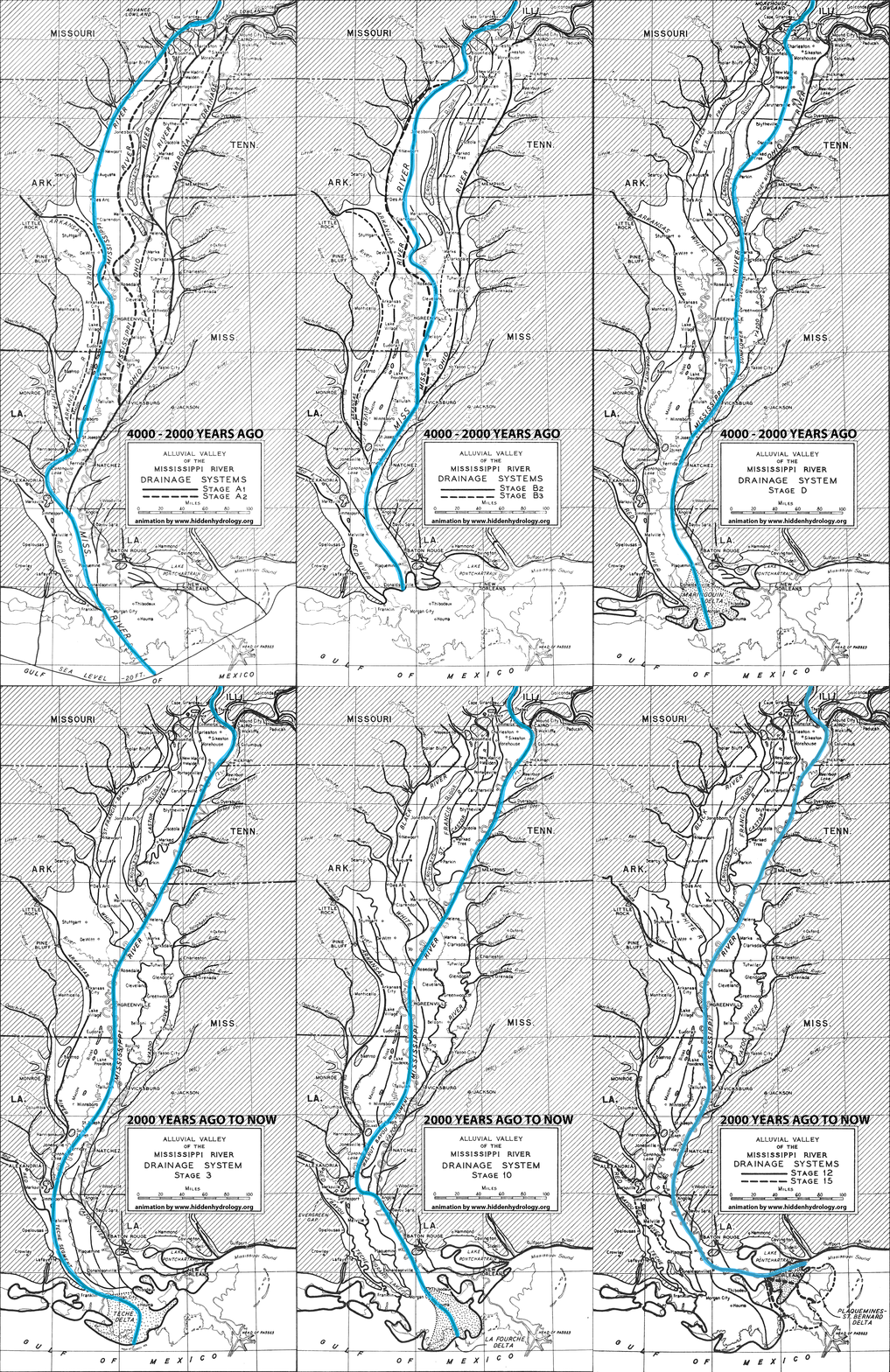
From the recent post, Indeterminate Rivers the Geological Investigation of the Alluvial Valley of the Lower Mississippi River by Harold N. Fisk offers a wealth of information on landscape change.  When I first saw the series of maps the idea of showing the shifting path of the river came to mind – and I envision a much more intensive and animated idea could be applied to the color map series (from the original post) to illuminate not just the static traces but the actions of this hidden hydrology over time.

The simple animation below is based on the maps in the report that discuss the formation of the valley and the current configuration of the meanders.  For reference, this map isn’t an attempt to make  conclusions, but to activate some of the data represented in 2-D format in the report – showing the breadth of change of the main path of the Mississippi over the course of 4000 years of change.

More explanation of the specifics found at the page ‘Mississippi River Change’.

Save

Save

As outlined in my previous post, the San Francisco Bay Area is loaded with many hidden hydrology focused activities and groups working throughout the region.  This follow-up post will address the amazing depth of resources available for historical maps and other resources for mapping and exploring lost rivers and buried creeks in the bay area.

The first place to look would be the amazing Guide to San Francisco Bay Area Creeks, which has an amazing array of creek maps covering the entire region, published by the Oakland Museum of California, many of which were also funded by the California State Water Resources Control Board and U.S. Army Corps of Engineers. You can select maps or use a sort of useful Graphic Creek and Watershed Finder to select areas via map.

The site itself isn’t just a portal to information, but includes a lot of maps, historical and contemporary as well as supporting info like Creek’Zine with stories of local history, or a glossary of creek and watershed terms.   Each map page offers links to the many creeks either through text or clickable smaller basin maps, like San Francisco.

This scaling linking allows for easy drilling down to subwatersheds, for instance to Islais Creek Watershed in San Francisco. you find more info and specific clickable elements,

Clicking on the map triangles yields more info – ostensibly what is found on the full printed map, but it’s nice to have really easy access to this online, in some depth.  An example is found in the link to Glen Canyon:

The key shows the depth of information available, including the basins, man-made and natural drainage infrastructure, waterbodies, fill and other structures.The sidebar has keyed Historical Features, circa 1850 including ‘Creeks, buried or drained’, ‘Ephemeral creeks’ and areas that were filled.

Each map page also links to a number of historic or descriptive maps that outline water systems, topography or juxtapose the new and the old.  For Islais Creek, above, a 1896 USGS Topographic map shows some source materials and evolution of the area prior to filling the historical features.

The main excerpt maps are zoomed in versions of the larger printed maps, which are pretty dramatic (in their digital form).  This one showing Oakland and Berkeley areas in the East Bay.   “The printed version of this map presents both the historical and modern hydroscapes of the western drainages of Northern Alameda County.”

I can stare at these for hours even though I don’t live there, that’s how fascinating they are.  Click on the map to download a PDF, (3.0 MB)

An excerpt shows the detail (in this case around Lake Merritt) which is pretty representative of the maps.

I’m still amazed at the coverage of these maps, and although some are getting old, the overlay info should still be pretty accurate even in the boom of development and redevelopment happening in the area.  There are maps for purchase and download, along with some GIS and KMZ files for further mapmaking opportunities.  As San Francisco proper is (mysteriously?) the only version of the PDF map not downloadable, I purchased a few of the printed maps so will see how they look when they arrive in early January.

As an added bonus, I really liked this animated map showing San Francisco in 1869 and 2007. (will launch in new tab for a bigger version).  This shows a simple evolution of the entire city, rotating through 150 years of change.  A dramatic difference, I’d say.

An additional find was the Guide to East Bay Creeks, a brief series of essays by Sarah Pollock, Shelby Hall & Christopher Richard.  Now only available online, which includes narratives for the specific hydrological and ecology – sort of a regionally specific creeks 101.  From the intro:

“Throughout the East Bay city dwellers are recognizing that even in urban areas we have wildlands valuable to humans and other animals. These people are learning ecological relationships through direct experience, and they are hoping that ultimately there may be an attitude shift, a cultural recognition that even city dwellers are an integral part of a living system.”

The previously mentioned San Francisco Estuary Institute, which was responsible for some of the maps available above at the Guide to San Francisco Bay Area Creeks, and is a wealth of information on their site, both in terms of research reports but also GIS information. In their Data Center, you can search for tools, services, visualizations and other resources applicable to resilience and historical ecology among other topics.  Their work extends throughout the region, but has many overlaps in the Bay Area, including the GIS data for the Alameda Creek Historical Ecology study mentioned in the previous post, and rich data sets such as The San Francisco Bay Shore Inventory: Mapping for Sea Level Rise dataset provides a comprehensive and consistent picture of today’s Bay shore (up to MHHW + 10ft) for all nine Bay Area counties.  These data are available in ESRI ArcGIS file geodatabase and Google Earth KMZ format.”

Building on the last study, the SFEI folks also had a link to an awesome Historical Ecology resource, the online viewer for U.S. Coast Survey Maps of SF Bay, which provides maps of shoreline “Under the direction of some of the leading American scientists of the 19th-century, the USCS created exceptionally accurate and detailed maps of the country’s coastline. In the San Francisco Bay Area, these surveys (commonly referred to as “T-sheets”) are the most important data sources for understanding the physical and ecological characteristics of the Bay’s shoreline prior to Euro-American modification.”

The interface could use an update, but with a bit of digging the T-Sheets are available for download and are rotated and georeferenced, and includes raster and vector files. The image above I rotated and cropped – and you see that, aside from utility, these are some of the most beautiful maps.  Another zoomed excerpt.

I’ve dug into the T-Sheets for the Seattle area, and they are some great maps with pretty extensive coverage.  A few links provide a good tutorial, including a T-Sheet Users Guide authored by Robin Grossinger,  From their summary: “This guide discusses the historical maps of San Francisco Bay produced by the United States Coast Survey (USCS) and their application to present-day environmental efforts in the region.”

There are also Seep City maps, the project mentioned in the previous post, including print maps, atlases, and a forthcoming book available for purchase from Joel Pomerantz.  Another regional resource worth checking out is the Watching Our Watersheds – interactive mapping from the Santa Clara Valley Water District, which provides a good example of online interactive water tools using Google Earth.  Check it out and download the data at the link.

I’d be remiss without touching on some of the cool historical map sources, including a few gleaned from the Guide to San Francisco Bay Area Creeks page, including this interactive map from the 1860s

San Francisco c. 1860 – click to open in new tab
Topographic map from the 1890s with original creeks in blue, marshes in green, and modern land fill in pink

More to come as I’ve barely scratched the surface on SF Bay area and have not fully looked at historical sources other than those mentioned elsewhere.  This may be due to the amount of info available rivals most cities.  Kudos to the people at working in this region for providing inspiration and great precedents for work to apply elsewhere.

And if you haven’t yet, read the first of this series – Lost Creeks of the Bay Area – Part I to learn about the groups working in hidden hydrology, art, and urban exploration.

I had the opportunity to see Kate Orff from SCAPE speak a few weeks back at University of Washington, and it was inspiring to see the mix of project work and activism that is the mark of this creative firm.  This project aligns nicely as it is featured in her new book, Toward an Urban Ecology and is another example of ecological design in an urban context.  She focused on some of the older projects in her talk, but this is one I’ve been waiting to explore here at Hidden Hydrology, the Town Branch Commons in Lexington, Kentucky.

scape_aerial-perspective

The project unique example of using the historical hydrology and geology as design inspiration – not a true daylighting but falling somewhere in the middle of the continuum from art to restoration.    From Architect’s Newspaper, a recent post SCAPE turns Lexington, Kentucky’s long-buried water into an asset provides a pretty extensive visual overview and some description into the project that complements the overview in the book.

“Town Branch Commons weaves a linear network of public space along the 2.5 mile path of the historic Town Branch creek in downtown Lexington, Kentucky. Once a waste canal, sewer, and water conduit for the city, the buried stream channel of Town Branch is an opportunity to reconnect the city with its Bluegrass identity and build a legacy public space network for the 21st century. Rather than introducing a single daylit stream channel into the city fabric, the design uses the local limestone (karst) geology as inspiration for a series of pools, pockets, water windows, and stream channels that brings water into the public realm.”

scape_plan

The renderings show the movement of water and the use of stone to embody the conceptual ideas of the Karst geology, which is responsible for the landscape of disappearing and reappearing springs.  A more expansive overview of the landscape type from the International Association of Hydrogeologists (IAH) site describes it as:   “A landscape formed by the erosion of bedrock, characterized by sinkholes, caves, and underground drainage systems. Many of the surface features are due to underground processes of the weak acids of groundwater dissolving the rock and creating a varied topography.” 


scape_diagram_water

This is seen in the design concepts for the spaces that are woven through the corridor, an approach referenced in Toward an Urban Ecology as a ‘Geology as Materiality’ (p.38).  The Karst metaphor is incorporated with orderly frames, referencing with geology within a semi-formal urban context that softens the spaces while maintaining functionality.  This is where the design-centric approach would differ from the more formal restoration, referencing a key hydro-geological precedent in an urban context.  As mentioned in the book ‘Towards an Urban Ecology’:  “Town Branch is recast as hybrid hydrological and urban infrastructure, creating defined and safe spaces for water, pedestrians, bicyclists, and vehicles along its path.  In the downtown core, streets are realigned to make way for an extended public realm, where water is expressed not at the surface, but underground, as rainwater-fed filtration gardens clean the waters of Town Branch before entering the culvert below.” (p.36)

scape_karst

The concept of the sunken areas allow for an immersive experience within an urban realm.  The separation of grade and edges of formal and natural provide variety of experiences that provide a model for ‘daylighting’ and applied urban ecology that is both functional and artistic, aesthetic but with some ecological rigor.  As mentioned in A/N: To create freshwater pools—SCAPE calls them “karst windows,” in reference to similar naturally occurring formations—the design will tap old culverts (essentially large pipes) that previously kept Lexington’s karst water out of sight.

scape_simple_section

And more dramatically enveloping in a recreation of the Karst geology and incorporation of moving, dynamic water, while also allowing for physical access to the water, a rare treat in urban areas.  This image shows waterfalls near Rupp Arena, a high-visibility area adjacent to more formal plaza spaces at surface.
scape_rendering

The nature/culture connection is strong, and a unique model that is about the landscape of Lexington.  As mentioned in A/N: “Here it’s all about finding a unique identity framed around a cultural and geological history of a place,” said Gena Wirth, SCAPE design principal. “What’s replicable is the multipurpose infrastructure that unites the city, its story, and its systems.”

scape_aerial-render

Water Walks

An interesting part of the narrative is not just the project design, but the generative strategy used by SCAPE to develop the project.  Those already familiar with another SCAPE project, the fantastic Safari 7, (which will get some documentation here soon) will note some similarities of the use of place-based audio and mapping, They documented a public outreach process Town Branch Water Walk which aimed to connect residents to the local landscape.  From their site:

“The result, Town Branch Water Walk, is a self-guided tour of downtown Lexington’s formerly hidden water body, Town Branch Creek, with content developed together with University of Kentucky students. The design intervention is not a physical landscape, but a communication tool– using podcasts, maps, and walks for the interpretation of urban systems. The Water Walk gives a broad understanding of the biophysical area around the Town Branch, reveals the invisible waters that run beneath the city, and demonstrates some of the impacts each resident of Lexington can have on the river and its water quality. By sharing how water systems and people are interrelated—both locally and globally—the Town Branch Water Walk makes stormwater quality relevant, linking it with the history, culture, and ecology of the city.”

scape_walk2

The walking tour is accompanied by audio that can be used in situ as podcasts, and as more formal walking or bike tours – and this model/map was also used at events along to provide  listening stations for the various stories.

scape_walk1

There’s more on this process worthy of additional exploration and future posts, and check out the audio and links at www.townbranchwaterwalk.com

All images via SCAPE

Save

Save

Save

Save

Save

Save