In Northwest Portland, Oregon, red-legged frogs living in Forest Park face a dangerous commute in the fall and winter, traversing from their upland homes down to the spawning grounds adjacent to the Willamette River. The species typically is found in conifer hardwood forests that have an aquatic-terrestrial connection to ponds and wetlands as part of their life cycles.

Northern Red-legged Frog

The degree of landscape changes inherent over time is seen in a series of maps spanning the previous century and a half of urbanization, centered near present-day Harborton, the location of a critical habitat connection for the frogs. From the original surveys in the 1850s, the area was lightly developed, and the areas noted as โ€œTimber, Fir, Cedar, Maple, Hemlock, Yew, etc.โ€ showing the zones that would become modern Forest Park and the uninterrupted upland to lowland connections along the Willamette River.

1855 General Land Office Survey Map (via BLM)

By the 1900s and the mapping from the USGS Topographic Survey, some development was happening along the water in the early town of Linnton, and the rail lines were built that started to sever these historical ecological connections.

1897 USGS Topographic Survey (via TopoView)

The current aerial image shows the clear line marking upland to lowland as separated by roadways and more impervious industrial development located along the Willamette River, reducing the amount of shoreline habitat.

2024 Aerial Image (via Google Earth)

The historical upland to lowland conditions has been radically disturbed along the entire margin of Forest Park. We could infer from the series of maps that historically, the frogs had significantly more habitat options along a much larger zone (and even more if you look at maps south of here showing additional lakes and wetlands), and that over time, a series of human-made linear barriers (railroad, roads) and urbanization cut off connections while reducing overall shoreline habitat. This ultimately resulted in a severe decline in several species populations, including the red-legged frogs.

As you see from a zoomed-in area, the major impediment for the frogs is a gauntlet, including a four-lane Highway 30, another smaller side road, and railroad tracks that prevent frogs from safely accessing the breeding area around the Willamette. Described by many as a real-life game of Frogger, the result is documented mass killings of frogs that attempt migration to these zones in rainy seasons.

Frogger (via Atari Age)

As a response to the negative impacts of the species, an intrepid group of volunteers has implemented what they call the Frog Taxi. Starting in 2013, as documented on the site Linnton Frogs, the group has mobilized annually to collect frogs from Forest Park, transporting them across Highway 30 and other roads and railroad tracks to get to the breeding around along the Willamette, and then relocating them back across the roadway to the upland. You can see some stats of the groupโ€™s work from 2013-2021. The work has continued, and Oregon Field Guide recently did a story on this yearโ€™s Frog Taxi, which provides a great overview of the process the volunteers undertake to save this remnant population of red-legged frogs.

Taxi to Where?

Making it across the barrier alone or via taxi only solves one part of the equation. To fully connect the life cycle, viable habitat conditions need to be provided for suitable breeding conditions on the waterside. The landscape of the entire edge of the area used to include the multiple connected ecosystems lakes along a long riverfront edge, including Guildโ€™s, Kitteridge’s, and Doaneโ€™s, which is notable as their surrounding wetland margins have been impacted.

Once the frogs can reach the site, the original habitat must be restored to provide suitable conditions. Currently owned by PGE, the taxi โ€œdrop-off’โ€œ site is the locus of additional restoration efforts, as noted from the PGE site related to the Harborton Habitat Project:

โ€œThe site is one of the largest known breeding grounds for northern red-legged frogs, an amphibian species classified as โ€œsensitiveโ€ by the state of Oregon and a โ€œspecies of concernโ€ under Federal listing status. Additionally, the property is situated where the Willamette River meets Multnomah Channel โ€“ a perfect spot for juvenile salmon to rest and find food on their way to the Pacific Ocean.โ€

Harborton Habitat Restoration (via PGE)

The overall goal is to move from taxi service to more uninterrupted connections from the upland forest to the pools to eliminate the game of Frogger, as well as eliminate the need for volunteers to fill the role of taxi drivers. The next iteration involves increasing overall habitat mobility through an amphibian tunnel that will funnel the frogs along the edges and allow them to move under the roadways and rail lines, connecting Forest Park directly to Harborton. As noted, the Harborton Frog Crossing Project proposed this new connection:

โ€œIn an effort to save the dwindling frog population, local wildlife officials and the Oregon Wildlife Foundation have proposed to build a highway underpass to grant the amphibians safe passage. The project calls for a concrete culvert beneath Northwest St. Helens Road and Marina Way to help the frogs reach their preferred breeding grounds.โ€

Other studies are helping pinpoint more specifics related to the locations and magnitude of the problem. There is funding to assess the mortality of the frog populations is underway by Northwest Ecological Research Institute (NERI), and funded by the Oregon Conservation & Recreation Fund Projects and the Oregon Zoo. The specific goals hope to inform the amphibian tunnel, as they state:

โ€œA wildlife undercrossing and/or creating improved wetland spaces that do not require road crossings are the primary proposed solutions. These are expensive, infrastructure-based solutions, and more data is required to find the most appropriate path forward. Specifically, increased data on the rate and location of frogs being killed at road crossings will inform timing and movement patterns to find the best solution.โ€

Thanks for reading Hidden Hydrology! Subscribe for free to receive new posts and support my work.

Wildlife Ways

The Oregon Wildlife Corridor Action Plan (ODFW, January 2024) notes that there are naturally occurring barriers to wildlife movement, but the most critical are human-caused barriers that block movement. Within the context, they also discuss how barriers are relative to species, as quoted:

โ€œThe most readily apparent human-caused barriers to animal movement are the physical structures that impede or outright prevent connectivity, such as buildings, fences, roadways, solar developments, and dams. The response of wildlife to structures varies by structure type and by species. For example, a fox may be able to make its way around a large industrial complex, whereas for a frog the complex might represent an impassable barrier. While not all physical structures will completely block animal movement, these features are often associated with increased risk of mortality for wildlife due to collisions, entanglement, entrapment, and persecution. Two of the most prevalent physical impediments to wildlife connectivity are roadways and fencing.โ€

Wildlife crossings, in general, are gaining momentum with various overpass and underpass options that direct and funnel species from habitat areas and provide safe passage through dangerous areas. The focus is often on larger species, specifically deer and elk, here in Oregon, moving between fragmented parcels of land. There is also the potential to reduce vehicle-wildlife collisions, with specific action plans to provide more solutions. These are dynamic opportunities to connect large habitat patches but come at a steep price.

Wildlife Crossing (via Caltrans)

The types of crossings also need to be adapted to the species’ needs. My favorite is the Crab Bridge on Christmas Island in Australia, which provides an almost vertical climb and spans over a roadway to facilitate the migration of red crabs.

Crab Bridge (via Christmas Island National Park)

Another analog is the work being done for fish passage, including strategies for repairing culverts to provide better access for fish, installing tidal gates to better allow movement up and downstream in fluctuating water cycles and implementing fish screens to limit access to certain waterways while providing access to certain areas necessary for the species to thrive. These are less visible than the larger wildlife connections; however, they also come at a significantly smaller cost and can be localized to specific species migration corridors.

The amphibian connections are a microcosm of these types of projects. More modest in scale, but growing in popularity, there are numerous examples around the globe of different types of passages that work for different amphibian species. The hope is that these will continue to do some of the necessary repair work for the severed connections between critical hydrological habitats, hopefully helping the Harborton Red-Legged Frog populations survive and thrive and give the taxi drivers a break.

Amphibian Crossing example from Doรฑana National Park, Spain (via Research Gate)

If you are aware of other examples of strategies being used to allow amphibians or other species to facilitate movement in fragmented landscapes, particularly those that are disconnected from historical waterways via development, I would love to hear about them.


BONUS: HIDDEN HYDROLOGY READINGS


Note: This post was originally posted on Substack on 12/11/24 and added to the Hidden Hydrology website on 04/22/25.

The idea of Detroitโ€™s Ghost streams work bridges my two interests by connecting the dots of Hidden Hydrology and Climate Change, a topic that I will revisit often. The post discusses research in Detroit, Michigan, that connects buried streams and flood risks, using historical ecological information overlaid with redlining map data to show the potential negative impacts on historically marginalized communities.

A recent podcast โ€œWhat We Can Learn from Ghost Streams.โ€ (Next City, 05.01.24) talked about Bruce Willenโ€™s work on Baltimoreโ€™s Ghost Streams, as well as the work in Detroit, featuring the research of Jacob Napieralski, a professor of Geology at the University of Michigan-Dearborn. Give the podcast a listen, and as a good companion, he also goes into more depth about this work in Detroit in this article โ€œHow ghost streams and redliningโ€™s legacy lead to unfairness in flood risk, in Detroit and elsewhere.โ€ (The Conversation, 03.19.24)

The basis of the research is what are known as โ€˜redliningโ€™ maps. For a little background, the Home Ownersโ€™ Loan Corporation (HOLC) was a government agency created to assess financial risk for mortgage lending for real estate. The tool was used to systematically institutionalize racist policies in cities around the United States by assessing areas inhabited by people of color, poor, and immigrants as much higher risk than those where rich, white residents lived. The process led to disproportionate investment in low-risk neighborhoods and marginalization in those deemed โ€˜hazardousโ€™ or โ€˜high-riskโ€™ zones, which ultimately created concentrated areas of poverty through a lack of economic opportunities. The redlining has become a shorthand for the inequity of communities, and mapping allows for looking at how these historical impacts persist in cities today.

Detroit Redlining Map (The Conversation)

The research overlays these maps with other data to extract how the legacy of racist home lending in the past has created more risk of impacts like flooding today. The goal of the study was โ€œโ€ฆ to determine whether a history of waterway burial and/or redlining influenced the overall flood risk of communities today.โ€ The data revealed that the burial of streams and wetlands did impact current risks in the historically marginalized communities. As Napieralski mentions in the podcast:

โ€œFlood risk is very intricately linked to history, and by ignoring history we may be missing some clues that help us move forward.โ€

Rather than dwell on the negative, the authors mention the positive side of the analysis, noting that most communities have this data and that it can be useful in focusing on where best to employ solutions like green infrastructure or nature-based design solutions, saying: โ€œIf communities want to protect residents from flooding, itโ€™s crucial for them to map and understand their โ€œhidden hydrology.โ€

Buried But Not Dead

More in-depth exploration of the research is found in the journal article โ€œBuried but not dead: The impact of stream and wetland loss on flood risk in redlined neighborhoods.โ€ (City and Environment Interactions, January 2024). The study was authored by Napieralski along with Atreyi Guin, and Catherine Sulich, and their research outlines the mapping to overlay the Home Ownersโ€™ Loan Corporation (HOLC) maps showing redlining categories, using buried streams and redlining grades to estimate flood risk. The mapping processes were interesting, including the use of historical documents and Digital Elevation Models (DEMs) to infer buried water bodies and flood risk:

โ€œAlthough the actual stream channel or wetland surface were buried and built upon, high resolution elevation models (e.g., LiDAR) can be used to reveal the remnants of distinct depressions from these structures, such as meandering stream valleys, in heavily urbanized landscapes. The authors assume that, although no longer occupied by active streams or wetlands, residential homes built on buried stream valleys will experience an elevated probability of flood risk not included in floodplain maps, but also that the process of burial and removal were influenced by income and race embedded in some of the racist housing policies of the 1930s and 1940s.โ€

Mapping Analyses of Buried Streams and Filled Wetlands and Flood Risk (City and Environment Interactions)

Using data from First Street Foundationโ€™s Flood Factor, the flood risk of parcels is rated 1 to 10 based on the chance of flooding in a time interval There were also additional criteria that were integrated into risks associated with different types of impact, sorted by HOLC grade. As the authors mention: โ€œFlood risk is disproportionately distributed, caused in part by outlawed, racist housing policies. Understanding where risk is highest can help identify optimum locations for adaptation measures to minimize flood damage in these neighborhoods.โ€

Figure from the article, showing flood risks by type of area โ€œassociated with inland, coastal zone, ghost streams, and ghost wetlands within redlined neighborhoods.โ€

This does bring up why mapping these streams and wetlands is important. They provide a basis for analysis by using other data as cross-sectional overlays, unlocking connections between impacts that may, on the surface, be unseen. The connections of this work to climate change, of which flooding is a key impact, are clear, as changes in precipitation and storm intensity make flood risks more frequent and more damaging. The authors conclude the

โ€œ[The]โ€ฆrole of redlining in present-day flood risk applies to cities throughout the United States, as does the importance of mapping ghost streams and wetlands to inform residents of the role โ€œhidden hydrologyโ€ may play in increasing flood risk.โ€

Thanks for reading Hidden Hydrology! Subscribe for free to receive new posts and support my work.

Note: This post was originally posted on Substack on 05/08/24 and added to the Hidden Hydrology website on 04/23/25.

Building on my recent post about the anniversary of the catastrophic flooding of Vanport, I had the opportunity to visit some of the events at the Vanport Mosaic Festival from May 25-June 5. One highlight was a series of tours being offered as part of the events on Memorial Day weekend. The tour started at the Portland Expo Center and looped through key areas of the site, and it was exciting to get access to a few areas that are typically off-limits to people on a regular basis. It was also available as a self-guided walking tour, so they had maps for referencing key Vanport locations overlaid with current conditions

Vanport Tour Map (via Vanport Mosaic)

The back side of the map is supplemented with imagery of sites along the route, giving a feel for what it was like during the height of Vanport. It’s interesting to see these spaces and activities from 70 years ago, and for the most part discover that few traces of this still exist on-site.

Vanport Tour Map (via Vanport Mosaic)

The tour took a bit over an hour, and was led by Clark College professor of geography Heather McAfee, who layered stories and facts onto the tour, and demonstrated a passion for the need to tell the stories of Vanport more widely. While I wished we were able to hop out and explore a bit more, there were a few stops along the way, including this kiosk at one of the parking areas.

A Place in Time Called Vanport – Kiosk

The trail adjacent to the site led Force Lake, one of the amenities of the original Vanport community that was formerly adjacent to the original Recreation Center, and had beaches at the margins. The perimeter is now overgrown and a large wetland zone that is mostly inaccessible except from some narrow paths or to golfers on the west side.

Force Lake

Those other uses are a part of the story. South of the kiosk is a good orientation to the current land use of the majority of the Vanport site today with the western portions occupied by Heron Lakes Golf Course and portions of the east side of the site occupied by Portland International Raceway (PIR), making most of the site not publicly accessible.

Heron Lakes Golf Course
Track at Portland International Raceway (PIR)

Both of these uses contribute to the lack of remnants that remain from the original Vanport site. As our tour wove between the two atop short levees, we struggled to look from map to site and make any meaningful connections, so disconnected these areas were from their original site, with staring golfers wondering why a seemingly lost tour bus was lumbering around in the middle of nothingness as they went about their rounds.

One area that was protected, through the advocacy of groups wanting to preserve some remnant, the old foundation of the original Theater is still visible on a small margin adjacent to one of the sloughs, protected from construction of PIR (Another remnant area of roadway, a portion of North Cottonwood Street) was incorporated into the straighaway of the racetrack). While indistinct, even this tracery of crumbling foundation serves as a powerful marker, even more so due to the almost complete erasure. Many on our group walked on the surface, paused in a moment of silence, and then moved on. It seems odd, but it had a power, and seemed almost sacred, becoming a tangible touchstone for the past.

Remnant foundation of original Vanport Theater building

McAfee (here pictured) used this location, pointing up at the top of a tree to show the relative height of the floodwaters, which were between 22-28′ high depending on where on the site one stood. As McAfee mentioned, people came into the theater to warn of the breach, shouting:

“The Dike has Broke!”

Seeing this and imagining a water line many feet above your head, coupled with the fact that there was a direct sightline here to the original railroad embankment breach point along the western edge of the site, it hammered home the immensity of the event. It also left me in amazement that even more people hadn’t perished.

Tree marking the height of flood waters

The southern apex of the tour swung by Drainage Pump No. 1, which was built in 1917 and worked to remove water from the interior of the levee bottoms. While it helped slow the flood a bit, the fact that it pumped water outside into already swollen creeks meant that it was fighting a losing battle. The pumps still work to dewater the interior the areas today as part of the larger drainage system.

Original Drainage Pump Station

The tour looped to the southeast and a second breach point, then wove back by the original site entrance along Denver Court before returning to the EXPO center. One stop adjacent was a larger wetland area, with another public sign adjacent to the dogpark that also tells the story of Vanport.

Informational signage adjacent to dog park
Additional information marker from Oregon Travel Information Council

The Vanport Wetlands were adjacent to the site, nestled between PIR and the original Vanport site, and the EXPO center to the north. These and are protected today and support a range of wildlife, according to the Travel Oregon site: “This is an excellent site for waterfowl in winter, and southbound shorebirds in late summer, including Pectoral Sandpiper. Summering ducks include Cinnamon and Blue-winged Teal. Many swallows forage over the water in season. Check the wooded edges for warblers, vireos, and tanagers. Yellow-headed Blackbird has nested here. Red-shouldered Hawk appears occasionally, while American Kestrel, Red-tail Hawk, Osprey, and Bald Eagle are expected. Another 0.5 mi NW on Broadacre is Force Lake, a good place to view migrant grebes, ducks, and shorebirds.”

Vanport Wetlands Interpretive Signage
Vanport Wetlands

Vanport Mosaic Exhibits

At the EXPO center post-tour, there were a number of exhibits and groups showcasing topics related to Vanport, social & environmental justice, arts, and culture. The Vanport exhibit was a chance to explore many of the themes around Vanport flood, not just as a historical retrospective but as a way to use this to have new conversations around race. From the site:

“Join us for two weeks of memory activism opportunities, to explore and confront our local past and recent history of โ€œotheringโ€ and its tragic consequences. ย Through exhibits, documentary screenings, tours, theater, and dialogues we will celebrate the lessons of resilience and resistance as defined and told by historically oppressed communities.”

According to this article about the exhibit from OPB, quoting Laura Lo Forti, the Vanport Mosaic co-founder and co-director:

โ€œ…itโ€™s important to remember because I feel like we are experiencing yet another wave of collective historical and cultural amnesia.โ€ย 

Vanport Spirit mural

Lots of interesting side stories, including learning more about Levee Ready Columbia, working to protect from flood risk in the context of development and climate change in the slough today, as well as finding all the ways to access some local waterways via the Columbia Slough Watershed Council’s ‘Paddlers Access Guide‘. From the artistic side, a few related events include a documentary of Portland stories around trees, Canopy Stories, and a cool project exploring stores of place through music from the Portland Jazz Composers Ensemble “From Maxville to Vanport”. Similar geography, the Maxville Heritage Interpretive Center highlights a fascinating slice of Oregon history, and many other stories can be found via the Oregon Heritage Tradition, which “recognizes events that are more than 50 years old, reflect Oregon’s unique character, and have become associated with what it means to be an Oregonian.” Lots more folks at the event, so this is just a snapshot of a few.

Additional Stories

For a more permanent look at some of the art that looks back at Vanport, you take the yellow line north and stop at the Delta Park/Vanport MAX Light Rail Station. From the TriMet site outlining the Public Art on the Yellow Line, there are a number of elements that reference Vanport. Artist Linda Wysong was the primary creator of this stations installation, built in 2004. Elements include foundation remnants embedded in sidewalk, and a range of other specific elements.

These mosaic tile (the original Vanport Mosaic?) of community maps overlay the current Delta Park site onto the city grid of Vanport. Another map shows local river context within the location of the station.

Vanport Mosaic
Close-up of Mosaic

There are also these beautiful bronze railings, which are a nice touchand easy to miss if you’re not looking, featuring “cast artifacts from the Chinookan culture, Vanport and the Portland International Raceway.”

Bronze railing
Close-up of artifacts

Another piece that slipped my attention was some “CorTen steel sculptures recall rooftops adrift in the 1948 floodwaters”. There are also works by Douglas Lynch and Timothy Scott Dalbow are reproduced in porcelain enamel on steel, and “…a cast-bronze scupper channels stormwater into the bioswale below.” Lots I missed as it also seems like there an adjacent water quality pond a sculpture called “Waterlines” which had “Massive steel arcs allude to the engineered landscape and Liberty ships made by Vanport residents” as well as a “glowing monolith of stone, steel and acrylic symbolizes the unity of human and natural worlds.” Guess I need to make another visit.

The stories of Vanport are told in multiple locations, with the help of groups like Vanport Mosaic and local artists. However, as mentioned in the OPB story, our “collective amnesia” about historical events, especially those that involve racial inequities and displacement, requires us to first understand and next confront these narratives. As I talked with people around Portland, it was a mixed bag of whether people even knew about Vanport (many had not) or had any real knowledge of the significant (many, myself included, had not). Hopefully the Vanport Mosaic Festival continues, and energy around more ways to discuss, celebrate, and interpret this spatially, so that these hidden histories and made more visible and persist.


HEADER: Force Lake – image by Jason King (all images in post by Jason King unless otherwise noted).

The story of Vanport is a critical narrative woven into Portland’s water history, and gives a hint at the dynamic nature of river/city interactions, along with formative context for race and class relations that shaped the community, both in positive and negative ways.  This 2016 documentary from the Oregon Experience provides a compelling and well illustrated history of the Vanport community that’s worth a watch.

From the cover of the video: “During the early 1940s, Vanport, Oregon was the second largest city in the state and the single-largest federal housing project in the country.  Built quickly to house men and women coming to work in the Portland/Vancouver shipyards during World War II, Vanport boasted some 42,000 residents at its peak and offered progressive services for its diverse population. But one afternoon in 1948, a catastrophic flood destroyed the entire city, leaving about 18,500 people still living there suddenly homeless. Vanport tells the story of a forgotten city: how it was created and once thrived; and how it changed the region forever. It features first hand, personal accounts of former residents and dramatic, rarely-seen archival film and images.”

The origin story here is around World War II, and the wartime shipbuilding, and Henry J. Kaiser, who operated 3 major shipyards that built over – two in Portland, in St. Johns and Swan Island, and another across the river in Vancouver, which built over 750 ships and employed around 100,000 people at their peak in the early 1940s.

Kaiser Shipyards – Oregon Encyclopedia

In order to house the growing and diverse population of shipbuilders, who were coming for a mix of opportunity and patriotism, Kaiser proposed in 1942 to build what would become the largest wartime housing project in the United States, a new community of over 40,000 people in a 650 acre tract wedged between the Columbia River and Columbia Slough in North Portland. The plan of the community, completed in 1943, shows the general layout, including over 9,900 individual apartments, built cheaply and quickly. The size and diversity of the community, which included a diversity of White, Black, Asian, and Native American workers, as well as a large percentage of the workforce made up of women, who were recruited from all around the country to come to Portland to support the war effort.

Map of Vanport – Oregon Encyclopedia

From the documentary, the community also had a hospital, police station, library, fire station, transit, shopping, grocery, schools, recreation centers and even a move theater. While there was an effort to make the community livable, and improve ‘quality of life’, the goal was also production, with buses ferrying workers to and from shipyards, which operated 24 hours a day.

Aerial view of Vanport – from the Oregon Encyclopedia

The relationship of the plan is woven around water, and the history of flooding of the wetlands and sloughs within which Vanport was built could be said to be both amenity and omen. Some images from the documentary show life around these waterways, including beaches on one of the two lakes, and some exploration around the Slough and it’s tributaries that wove throughout the community.

Vanport Location – via Vanport (Oregon Experience)

As mentioned in the documentary, the cafeteria was located adjacent to the beach on one of the lakes, with water-loving cottonwoods woven throughout. And beyond what was referred to as a “slightly ill-kempt public park”, kids found waters of the Slough the real playground, using make-shift rafts to find turtles, bullfrogs, and tadpoles.

Vanport Location – via Vanport (Oregon Experience)

Post World-War II the idea was for the temporary city to be demolished, and as people starting moving out, some structures were removed. A housing crisis kept Vanport a necessity, as a combination of post-internment Japanese, blacks who could not find housing due to red-lining in the greater Portland area, and lack of housing for post-war returning soldiers, all combining to provide affordable, if somewhat ramshackle, housing for a variety of residents. There was also a Vanport College, founded in some of the vacant buildings, which eventually became Portland State University. For the growing Portland area, “mud on the shoes” meant you were from Vanport, which was seen by the greater Portland community through the lenses of racism as a slum.

In the winter of 1947-48, conditions started to shift towards catastrophe. Heavy snowfall coupled with more intense spring rains swelled the Columbia Rise, which flowed in mid-May at a rate of 900,000 cubic feet per second (cfs), which was almost double the normal flow. This led to the need for reinforcing dikes and sandbagging, along with regular patrols by the Army Corps of Engineers to ensure the perimeter was solid. At this point, there was a question of whether to evacuate, and an emergency meeting was held, but the thinking was that the dikes would hold, and if not people would get plenty of warming. A few days later things changed dramatically.

River Stage levels in late spring 1948 – via Vanport (Oregon Experience)

The entire Vanport area, as former lowlands, was surrounding on all four sides with dikes in order to keep the adjacent waters at bay. The massive vulnerability of the perimeter meant a lot of potential failure points. The dike along the railroad lines to the northwest of Vanport separated Smith Lake from the lower-lying Vanport area was just that failure point, seen in the map below.

Vanport Location – via Vanport (Oregon Experience)

The 30′ berm was ostensibly about protection of the railroad, so the integrity to hold that massive amount of water back during a huge flood event was less a priority, so water levels from Smith Lake started spilling over the dike, the railroad berm started degrading with water boils appearing and seeping thorugh, and on 4:17pm on the May 30th, the breach happened, as mentioned, a “600 foot section melted away.”

Railroad embankment failure – via Vanport (Oregon Experience)

Sirens blared, and people grabbed anything they could get their hands on to evacuated to nearby Kenton. As people recounted stories of “a wall of water” and climbed to their roofs to be rescued, it was exacerbated by the housing, which was built cheaply and without solid foundations, which began to float around, knocking into each other, as seen in the images below.

Houses in the aftermath – via Vanport (Oregon Experience)

The sloughs filled up with the initial flows, so people had 30 minutes to escape. With only one route available, Denver Avenue, the road was quickly jammed, and people started fearing that this area would also fail, so continued to sandbag and reinforce this zone, and people started walking through water as vehicles and buses were stuck. By Monday morning, Denver Avenue was also breached, along with other perimeter dikes, inundating the entire community. The extent of flooding wasn’t localized to Vanport, as it impacted the entire city and it was estimated to have caused over $100 million in damages throughout the basin. The displacement of 1000s of people meant that the flooding of Vanport was some of the biggest impacts, and they were long-lasting well after the water subsided.

via Vanport (Oregon Experience)

There have been a number of stories that have covered the events around Vanport life and flooding, including loss of life, as well as its aftermath, such as investigating the absence of accountability for inaction on evacuation and the lack of dike maintenance that could have prevented the disaster. I’ve not seen critical analysis in general of the general wisdom of occupying the spaces and places like Vanport and its flood susceptibility, which were chosen hastily to fill a need, such as emergency housing in war-time, but are perhaps much less suitable for people to live long-term. Should the city have been demolished after ship-building slowed? It shows the impacts of larger social forces on disasters, and the brunt of that impact being felt by frontline communities.

Some of that aftermath is capture in this snippet from the Oregon Encyclopedia: “Refugees crowded into Portland, a city still recovering from the war. Part of the problem was race, for more than a thousand of the flooded families were African Americans who could find housing only in the growing ghetto in North Portland. The flood also sparked unfounded but persistent rumors in the African American community that the Housing Authority had deliberately withheld warnings about the flood and the city had concealed a much higher death toll.”

Iconic image of man holding boy – via Vanport (Oregon Experience)

The erasure of that history is part of this larger story, with little remnant or physical marking of the place and event as what was left of Vanport was demolished, burned, or auctioned., which is now occupied in parts with West Delta Park, Portland International Raceway, and Heron Lakes Golf Course. As summed up in the Oregon Experience, there is to this day:

“Little to remind anyone of a ‘once thriving city.'”

It an important piece of history around both race, building, and hydrology to investigate in Portland, so expect to hear more about this. The Vanport Mosaic site provides a great opportunity to learn more, and there are some other films on the topic, including a documentary ‘Vanport and the Columbia River Floods of 1948‘, produced by the National Weather Service, and ‘The Wake of Vanport‘, produced by local independent paper The Skanner in 2016.


HEADER: Image of flooding with newspaper Headline – via Oregon Experience

As a followup to this post from about a year ago,ย Farming Tanner Creek,ย which delved into the history of Chinese farmers in Portland, this post picks that thread up by looking a bit closer at Marie-Rose Wong’s 2004 “Sweet Cakes, Long Journey: The Chinatowns of Portland”ย  The book is a comprehensive look at the history of immigration and settlement and contributions to the development of Oregon and early Portland, integration into the city and its architecture, and frank accounts of local institutional racism and displacement, most notably the impacts of the 1882 Chinese Exclusion Act.

As the title suggests, there were many incarnations of Chinatowns over the years in Portland focused around two zones. The first is the urban development zone of habitation that shifted shape running along the Willamette River to areas centered on Burnside and running to the north and south. These emerged first as a cohesive enclave, and later into a dispersed ‘non-clave’ that persists somewhat today in the small district of Old Town/Chinatown. The second is a zone of Chinese Vegetable Gardens further upland south of Burnside and west of 14th and provided more informal housing and opportunities forย  vegetable gardens.ย ย My focus here is on the latter, the farming zones inland along the banks of Tanner Creek, which Wong discusses and outlines their evolution over time, and how the fates of Chinese farmers and the creek were linked.

The three vicinities of Chinatown – From Wong, p.206

Much of the backstory here is found in the previous post, which focuses on a 2016 article byย Putsata Reang inย Oregon Humanities, entitledย โ€˜The Farmers of Tanner Creekโ€™ย along with some additional information from Tracy Prince’s bookย โ€œPortlandโ€™s Goose Hollowโ€.ย  In this case, I was pretty fascinated by the dual narratives of the erasure of the Chinese Vegetable Gardens in tandem with the erasure of Tanner Creek, which is illustrated in the series of maps in Wong’s book, spanning 1879 to 1908.

Via “The Farmers of Tanner Creek” – Oregon Humanities “Tanner Creek runs between Chinese gardens and shanties, circa 1892. Providence Park, the Portland Timbers soccer stadium, now stands where these gardens once did. “

I took the liberty of adding a few items of color to these maps, focusing on the routing of Tanner Creek and the extents of the Portland Chinatown Vegetable Garden Community. As mentioned by Wong the roads “…were needed to serve an expanding population, but the flood-prone Tanner Creek and the gulch that meandered through this area were dominant nature features that controlled much of the building potential of the region.” (211)ย  ย Thus improvements were required to tame this and create conditions better for development and expansion.ย  Wong continues:

“In 1873, the old wooden bridge that spanned the creek connecting B Street to a small number of residences collapses in the rise water fed by winter rains, necessitating replacement and improvement. In July of that same year, the City of Portland contracted Chinese workers to construct a 115-foot cylindrical brick culvert sixty feet below the level of B Street. The culvert was to run along the bed of the creek, with some infill of the gulch to permit construction of a new bridge. At six feet in diameter, the culvert was large enough for a man to walk through and was intended to provide drainage for at least a hundred years. This improvement made it possible to control, if not totally prevent, flooding of the creek and associated erosion along the creek bed and the embankment up to street level.” (211)

The control of flooding by installation of the pipe of Tanner Creek allowed for the Chinese to occupy the site for gardening, as it no longer flooded.ย  The first map from 1879 (p.210) shows a linear band of gardens along Tanner Creek parallel to B Street (current Burnside Street) which future road rights-of-way extending to connecting streets, but the creek had limited development of these roads, and the margins occupied with “Chinese Shanties”.

Between 1879 and 1889 the amount of area for Vegetable Gardens increased dramatically, from 3 acres to over 21 acres, as shown on the map below (page 214). The reduced flooding allowing for farming and Shanties to expand, filling the entire lowland zone.ย  The new plank road to the east and a new wooden bridge spanned new developments towards Jefferson to the west.

1890s – Trestle bridge, Chinese vegetable gardens, Portland High School Courtesy Oreg. Hist. Soc. Research Lib., bb007389

The Creek was still intact through this zone as well, however starting to get chopped up with development on the edges.ย  The ability of the Chinese to extract maximum production from this space was notable, as Wong mentions: “The immigrant gardeners… acted collectively, sharing the labor and the profits as they continued to farm the low-lying ground and slopes of the Tanner Creek Gulch.ย  The Chinese applied their extraordinary agricultural skills, shared by Cantonese immigrants of rural background, to successfully cultivate the land.” (212)

As seen above, at the time, there was some development, but more residents were moving near here and building larger houses, and for a short time the two lived in close proximity with little issue..ย  “Perhaps the year-round beauty of the gardens and the convenience of easily available low-cost produce enable two such economically disparate and cultural distinctive social groupsย  to coexist for many years.”ย  (215)

The 1901 map (below, from page 216) shows the impact of a new resident, The Multnomah Amateur Athletic Club (now the current The MACย ), which displaced some of these gardens by moving into 5 acres to the north of the creek, using the natural slope as a viewing amphitheater and building a clubhouse.ย  They also constructed considerable raised plank infrastructure on Alder Street, which eliminated gardens below there (but did keep the creek free flowing for a while longer). Farmers expanded the Shanties in existing areas, and moved to the area west of Jefferson where they installed new gardens and Shanties.ย  The creek it seems to also have started disappearing more in this period. The drawing doesn’t show a key to connote what dashed lines mean versus solid, but it’s probably not a stretch to imply much more culverting of flows, and the plank roads also serving to visually disconnect the creek from views of residents.

By 1908 the map (from page 217) expansion of the city was reducing (to around 11 acres) the area of gardens even more as land became more desirable. The Creek was removed through conversion of bridges and plank roads into surface streets, which filled up gulches.ย  This was a product of one of the “… city’s long-range projects for controlling flooding, raising the grade to accommodate roads, and encouraging urban residential development.” (218)ย  The area near the Multnomah Amateur Athletic Club purchased the land and “over the next few years, both Tanner Creek and the land adjacent to it were filled to permit final construction of the athletic club and nearby homes.” (219)

Together with a number of ordinances aimed at reducing the number of Chinese vendors selling products, and finally just outright banning street peddlers in certain areas.ย  As Wong concludes:

“Portland’s urban growth and expansion into the Tanner Creek area, the filling in of the creek, and the city ordinance that prohibited the rural Chinese from earning a living did irreparable harm to the fragile gardening community.ย  A reporter’s prescient statement in 1889, that the time would likely come when ‘the gulches [would be] filled up and used as building site,’ had come to pass, and the Chinese Vegetable Gardens community disappeared from the record after 1910.” (220)

It’s a wonder as well that it lasted as long as it did, within the rapid urban expansion and the racist undercurrents at the time.ย  The map sequence is a great snapshot in time to see Tanner Creek in the midst of Portland’s urbanization towards the end of the 19th Century. While, it is not totally clear graphically which portions of Tanner Creek were still remaining and which were buried, it shows a valuable sequential picture of the development of this portion of the city and how land shifted from that which had little value to some (and immense value for growing food for others) to becoming more necessary for further development. Gardens and creeks presented barriers to this progress and were slowly eroded and ultimately erased.ย ย Wong’s ‘Sweet Cakes, Long Journey‘ is an essential picture for understanding Chinese life and contributions to the history in Portland, of which the above is just one story.ย  However, it is a critical one in terms of hidden hydrology, showing the displacement of Chinatown Vegetable Gardens in tandem with development that slowly buried Tanner Creek, forever losing it’s productivity as a creek and its ability to support agriculture in the city.


HEADER:ย  1892 Image of Chinese Gardens and Homes in Tanner Creek Gulch, Photo courtesy of Gholston Collection – image via Oregon Humanities, “The Farmers of Tanner Creek

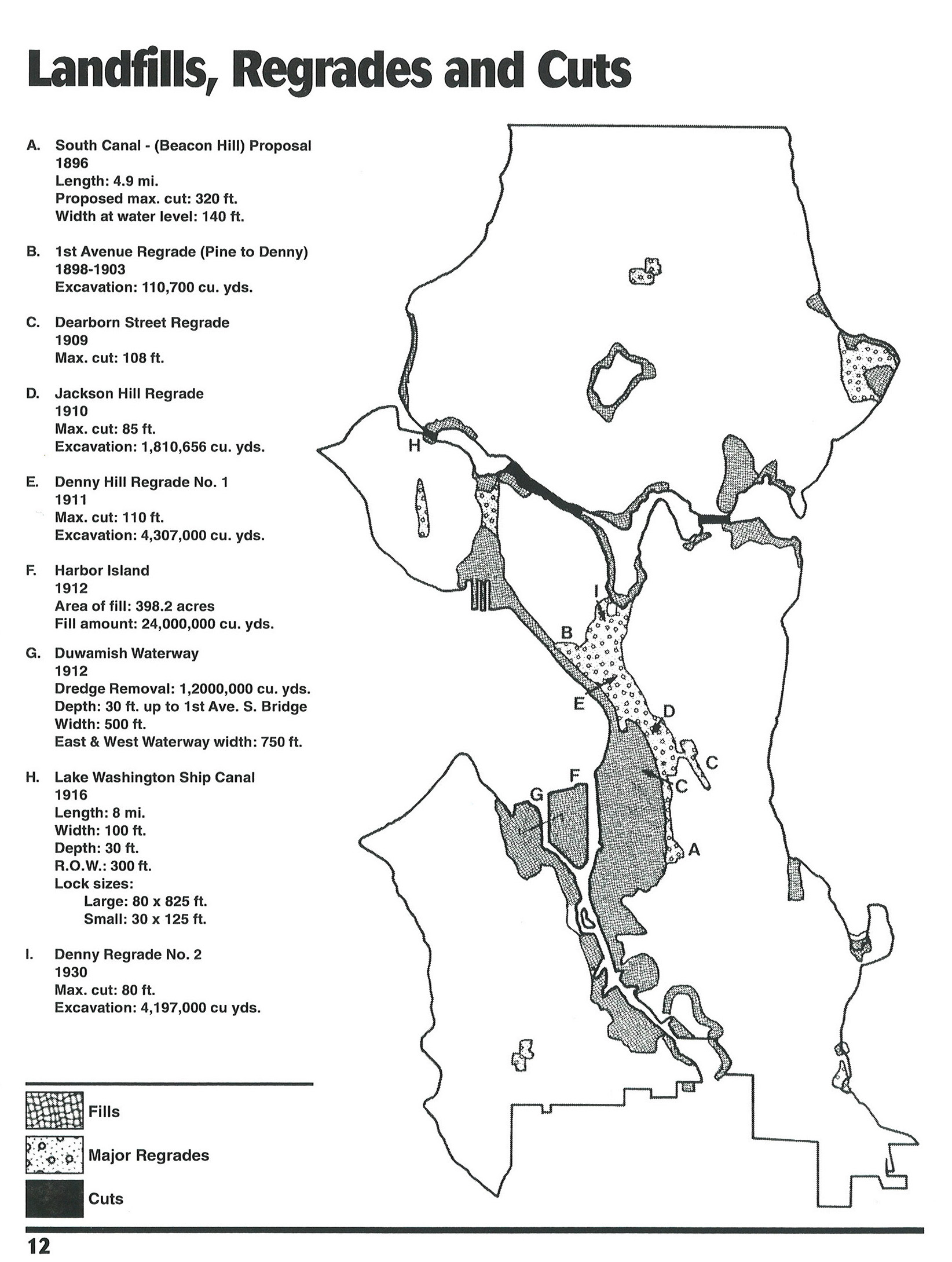
A quick one to show a map that captures the essence of the story of Seattle – this 1996 “Map of landfills, regrades, and cuts” outlines significant changes to the landscape of the city over the formative decades from 1896 to 1930. The source is the Seattle Municipal Archives, with a note of a sourceย  Seattle Engineering Department Digest, Special Commemorative Edition. A few interesting ones that aren’t labelled, such as the northernmost ‘Regrade’ which aligns in the vicinity of Northgate Mall and the wetlands around North Seattle College in the Thornton Creek drainage, and what I assume is also filling of the wetlands in the middle of Magnolia (just below the letter H).ย  Also, while I get that there was some manipulation of Green Lake, I don’t think it’d be technically correct to refer to that as a fill, at least in the traditional sense of ‘making land’.ย  It’s interesting to see these all captured in one figure. The impacts, of course, are well known.


HEADER: Denny Regrade – circa 1910, via Wikipedia entry “Regrading in Seattle”
\\ h/t to folks on the Reddit Seattle Group that linked to the map originally.